Cold email personalization is the single biggest reply-rate lever in B2B outbound in 2026, and almost nobody is doing it correctly. Woodpecker’s 2026 dataset puts the platform-wide average reply rate at 3.43%, down from 5.1% in 2024, while teams that personalize on real buying signals consistently clear 15% to 18%. The gap between those two numbers is roughly five times, which translates directly to pipeline for the same send volume.
Below is a working 2026 framework: the four personalization levels and their measured reply rates, seven signal tiers ranked by lift, the time economics of research per prospect, templates for each signal type, and the mistakes that look personal but repel. None of this replaces a working cold email outreach motion that handles sequencing, follow-ups, and deliverability; it layers on top of one and lifts the reply rate the sequence was already earning.
Key Takeaways
What Cold Email Personalization Actually Means In 2026
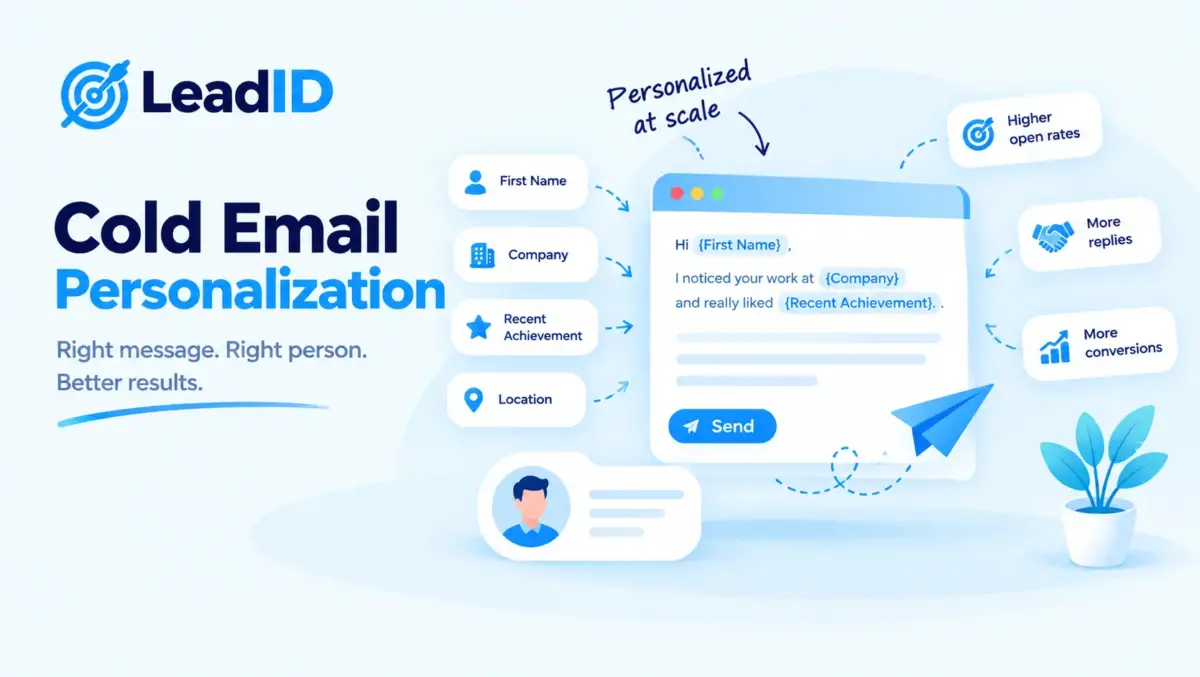
Modern personalization in 2026 is the specific, verifiable reference to something only this one prospect can claim: a funding round announced last Tuesday, a job change filed on LinkedIn ten days ago, a product update their team shipped, a sentence from a podcast they hosted. It is not a first-name merge field, and it is not a generic industry pain point written to look like research.
The reason the definition matters is that recipients can tell the difference inside five seconds. Decision-makers receive 150+ cold emails per week, and the pattern-recognition for “AI-generated opener with a scraped data point” is already fully trained. Signal-based personalization works because it fails that pattern test: the sender actually read something, and the message proves it.
The practical consequence is that signal-based writing now runs on two inputs. The first is a tight ideal customer profile so the signals you detect are relevant to begin with. The second is a working signal stack, scored by reply-rate lift, applied in order of strength.
4 Levels Of Cold Email Personalization (With Measured Reply Rates)
Instantly and Autobound both published 2026 benchmarks that break the practice into a four-level hierarchy. The reply-rate gap between each level is roughly 2x, and the gap between Level 1 and Level 4 is five to eight times.
| LEVEL | WHAT IT IS | AVG REPLY RATE | TIME PER PROSPECT |
|---|---|---|---|
| Level 1 | Name, company, title merge fields only | 5-9% | Under one minute |
| Level 2 | Role-specific pain point tied to seniority or function | 8-12% | Two to five minutes |
| Level 3 | One real company signal (funding, hiring, launch, tech change) | 15-20% | Seven to ten minutes |
| Level 4 | Stacked signals: company event plus person-level context plus behavioral trigger | 25-40% | Fifteen to thirty minutes |
The time column is the one every rep underestimates. A single sender doing Level 4 research every email caps near 20 to 25 sends per day, or roughly 120 sends per week. That is a fine number for enterprise or six-figure deals, and a terrible number for anything priced below $5,000 annual contract value. Match the level to the ACV, not to pride.
7 Cold Email Personalization Signals Ranked By Reply Rate
Not all buying signals carry equal weight. The seven below are ordered from strongest to weakest in independent 2025 and 2026 benchmarks, with the typical lift above a Level 1 baseline and where to find each one for free.
| TIER | SIGNAL | TYPICAL LIFT | WHERE TO FIND |
|---|---|---|---|
| 1 | Job change (new role, 0-90 days) | 4-5x | LinkedIn profile change date, UserGems |
| 2 | Funding round announced (last 60 days) | 3-4x | Crunchbase, TechCrunch, SEC filings |
| 3 | Hiring surge in the target function | 3x | LinkedIn Jobs, company careers page |
| 4 | Product launch, release note, or feature ship | 2-3x | Changelog, blog, Product Hunt |
| 5 | Public LinkedIn post or podcast appearance | 2-2.5x | LinkedIn activity feed, podcast indexes |
| 6 | Tech stack change (new tool detected) | 2x | BuiltWith, Wappalyzer |
| 7 | Mutual connection or shared alumni tie | 1.8-2x | LinkedIn mutual connections, alumni directories |
Pattern to notice: the top three tiers all involve a time-boxed window of change, which is the core premise behind intent data, and the sender who contacts a decision-maker first after a trigger event is five times more likely to win the deal (Growth List benchmark). Speed on signal detection beats depth of research when both are available.
How To Research Signals For Cold Email Personalization
The research step is where signal-based outreach usually breaks. Reps spend 25 minutes finding one weak signal, or two minutes finding none. A disciplined workflow pulls the strongest available signal in under eight minutes.
Step 1. Check the person first (3 minutes). LinkedIn profile for a job change in the last 90 days, recent posts, podcast appearances, and tenure in the current role. If a tier-1 or tier-5 signal lives here, stop and write the email.
Step 2. Check the company second (3 minutes). Press page, Crunchbase for recent funding, careers page for a hiring surge in the target function, product changelog. One tier-2, tier-3, or tier-4 signal is enough.
Step 3. Only then check the tech stack (2 minutes). BuiltWith or Wappalyzer for a recent tool change, especially a competitor to what you sell. Tier-6 is a fallback, not a primary signal.
If none of the three steps return a usable signal, skip the account rather than fake personalization. The next tier-1 account in the list is worth more than a Level 2 message to a weaker fit.
How To Personalize Cold Emails In Under 10 Minutes
The question of how to personalize cold emails without burning the day splits into a tight time budget: ten minutes end-to-end, five tasks with a hard cap on each. The budget below is the one top-quartile SDRs run by stopwatch, not by vibe.
| TASK | TIME CAP | SOURCE | DELIVERABLE |
|---|---|---|---|
| Open prospect profile | 60s | Job change flag, tenure, headline | |
| Scan 30 days of activity | 120s | LinkedIn Activity tab | Post, repost, podcast, or comment |
| Pull company signal | 180s | Crunchbase, careers page, changelog | Funding, hire, launch, release |
| Write the opener | 180s | Your research notes above | One signal, one offer, one ask |
| Review and send | 60s | Your sender tool | Final typo and fact check |
If any task runs over its cap, hard-stop and move on. A ten-minute budget enforced across 25 sends per day yields 125 personalized sends per week per rep, at an expected 15% reply rate.
The faster version of how to personalize cold emails at volume: batch 20 LinkedIn tabs in the morning, scan all 20 for strong signals in a single 20-minute sprint, then write all 20 openers in a second 90-minute block. Context switching between research and writing is the slowest version by far.
Cold Email Personalization Best Practices Checklist
Use the ten cold email personalization best practices below as a pre-send gate. Any send that fails one row loses roughly 30% of its expected reply rate; a send that fails three rows should not go out at all.
1. Verifiable signal. The opener references something that exists in public: a LinkedIn post date, a Crunchbase row, a changelog entry, a title change on a profile page.
2. Fresh signal. Nothing older than 90 days. Freshness beats cleverness every time.
3. One signal, not three. One strong signal reads as a note. Three read as a dossier.
4. Signal in opener, context in body. The signal earns the open. The body connects it to a specific problem you solve.
5. Subject line matches signal. If the opener references a Series B, the subject line references it too. Mismatched subject lines train the recipient to distrust the next three touches.
6. Low-friction CTA. One ask, under 20 words, that costs the recipient under five minutes to answer.
7. No fake familiarity. No “hope you are well”, no “quick favor”, no “big fan of your work” unless followed by a verifiable detail.
8. Professional public references only. Nothing about family, health, politics, religion, or physical appearance, even if the information is public.
9. Human review before send. Every AI-drafted opener gets a 30-second human read for hallucinated facts and tone drift.
10. Deliverability floor met. SPF, DKIM, and DMARC configured, sender inbox warmed for four to six weeks, send cap under 75 per inbox per day.
The ten rows above are the practical gate for every signal type and every send cadence. Teams that enforce the full checklist weekly, not just on launch day, see reply rate compound quarter over quarter.
5 Cold Email Personalization Templates By Signal Type
Every opener below is a Level 3 or Level 4 example built around a specific signal. First touches land hardest when the cold email subject lines and the opener reference the same signal, since mismatched subject-opener pairs cost roughly ten reply-rate points.
Job change opener (tier 1): “Saw you moved to Head of RevOps at Acme three weeks back, congrats. The two things that usually break in that first quarter are the lead-routing rules and the attribution model. Worth 20 minutes to compare notes?”
Funding round opener (tier 2): “Caught the Series B news yesterday, congrats to you and the team. Most 50-to-200 person SaaS companies hit a hiring-to-productivity gap in the first six months after a raise, and that is where our onboarding workflow usually plugs in. Open to a short call?”
Hiring surge opener (tier 3): “Noticed you have four open SDR roles in the last 30 days. Teams scaling that fast usually need their enablement content rebuilt before the fifth hire, not after. Happy to share what three similar teams did.”
Product launch opener (tier 4): “Just saw the new API endpoints you shipped on Tuesday. The webhook retry logic in the docs flagged a pattern we helped two other API-first teams solve last quarter. Want the write-up?”
LinkedIn post opener (tier 5): “Your post about moving from quarterly to monthly OKRs lined up with something we tested last year. One line that worked for us: scoring each OKR by confidence weekly, not just status. Worth sharing the template?”
Cold Email Personalization Techniques By Industry
Cold email personalization techniques are not interchangeable across verticals. The signal that lifts reply rate for a SaaS sale often repels an agency decision-maker, and a regulatory-filing reference lands with a fintech CFO but reads as noise to a logistics VP. The five industry-specific combinations below are what actually works in 2026.
B2B SaaS. Strongest technique is a product changelog, feature ship, or API endpoint reference. VP Product and Head of Engineering read their own changelogs weekly. Opener template: “Just saw the new {feature} shipped on {date}. Two API-first teams I worked with last quarter hit a {specific issue} 60 days after a similar launch. Open to a note on how they handled it?”
Marketing agencies. Strongest technique is a case-study or client-win reference pulled from the agency’s own blog or founder LinkedIn. Agency owners post wins constantly and expect peers to notice. Opener: “Your {client type} case study on {outcome} caught my eye. We built the attribution model that let two similar agencies prove the number upstream to their clients. Worth 15 minutes to compare?”
Fintech. Strongest technique is a regulatory filing, SOC 2 announcement, or ISO 27001 certification. Compliance news circulates in a small community and signals a buying cycle. Opener: “Noticed the SOC 2 Type II announcement last Tuesday, congrats. The vendor-review bottleneck that usually hits in the six months after is where our workflow plugs in. Want the overview?”
Logistics and supply chain. Strongest technique is a new partnership, warehouse opening, carrier announcement, or route expansion. Opener: “Saw the new {region} warehouse opening in the press release. Three logistics teams I worked with last year re-did their routing software in the 90 days after a regional expansion. Happy to share which tools they picked and why.”
Healthcare and biotech. Strongest technique is a clinical trial update, FDA filing, or research grant announcement. Opener: “Saw the Phase II trial update on {therapy}. The data-management stack usually gets re-tooled right after that milestone. Would a 20-minute comparison of what three similar programs picked be useful?”
Pattern across all five industry techniques: use the signal source the role actually reads, not the one that is easy to scrape. A Crunchbase row works for a VP Sales; a changelog line works for a Head of Engineering; a press release works for a logistics VP.
Cold Email Personalization Strategies By Deal Size
Cold email personalization strategies should be calibrated to average contract value, not applied uniformly across every account. The unit economics flip at four price bands, and the table below is the honest version of that math.
| ACV BAND | PERSONALIZATION LEVEL | DAILY SEND CAP | EXPECTED REPLY | COST PER REPLY |
|---|---|---|---|---|
| Under $1,000 | Level 1-2 (merge + role pain) | 100-150 | 6-9% | $8-15 |
| $1,000-$10,000 | Level 2-3 (role pain + company signal) | 40-60 | 10-15% | $30-50 |
| $10,000-$50,000 | Level 3-4 (stacked signals) | 20-30 | 15-25% | $80-150 |
| $50,000 and up | Level 4 (deep research per account) | 8-12 | 25-40% | $250-500 |
The cost-per-reply column reveals whether a personalization strategy fits the business. If a $5,000 ACV deal is running Level 4 at $400 per reply, the math is upside down. If a $100,000 ACV deal is running Level 1 at $12 per reply, the sender is leaving six-figure pipeline on the table.
The three practical cold email personalization strategies that fall out of this table: run tight Level 2 for high-volume SMB programs, run a mixed Level 3 (80% AI research with 20% human review) for mid-market, and run full Level 4 for every six-figure named account by hand. Switching between the three based on the inbound lead’s segment is the simplest version of a working strategy.
Cold Email Personalization At Scale: AI Versus Human
The honest 2026 answer is that AI handles tier 2, 3, and 4 signals reliably, and botches tier 1 and tier 5. Any decent LLM can read a Crunchbase row, a careers page, and a changelog. None of them can read nuance from a LinkedIn post or a podcast appearance well enough to earn the reply.
The working split is clear. Use AI research tools, inside a strong cold email software stack, for signal detection and tier 2 through 4 openers at volume. Reserve human research for tier 1 and tier 5 accounts, especially job changes and content references, where the writing has to prove it was actually read.
The math works out cleanly. A rep running 50% AI (tier 2-4) and 50% human (tier 1, 5) hits roughly 14% blended reply rate at 300 sends per week. Pure AI hits 8-10% at 500 sends per week. Pure human hits 20%+ at 120 sends per week. Pick the mix by average deal size.
Reference tool stack for cold email personalization at scale in 2026: Clay ($185 to $495 per month) or UserGems (custom) for signal detection, Lavender ($29 to $89 per month) or Smartwriter.ai ($49 to $124 per month) for AI-drafted openers, Instantly ($47 to $286 per month) or Smartlead ($39 to $174 per month) for sending with built-in warm-up, and a sender’s own LinkedIn tab for tier 1 and tier 5 human research. Combined cost sits around $300 per seat per month for a mid-market program, under $100 for lean SMB stacks.
Cold Email Personalization Mistakes That Look Personal But Repel
The failure mode of modern outreach is not under-personalization anymore. It is over-reach that reads as surveillance.
Mistake 1. Referencing something private or hard-to-find. If the prospect’s wife, kids, or weekend hobbies show up in an opener, the message gets forwarded to the security team, not replied to. Keep every reference to publicly posted professional content.
Mistake 2. Faking the “I saw your post” opener with no post. Vendors scrape posts that do not exist, hallucinate quotes, or reference activity from years ago. The prospect checks their own feed in two seconds and the credibility is gone.
Mistake 3. Compliments that reveal nothing. “Love what Acme is doing in the space” is not personalization. It is filler every recipient has read 500 times, and in 2026 it is a direct AI-generated-content signal.
Mistake 4. Stacking too many signals. Three real signals in one opener reads as a dossier, not a note. Lead with one strong signal, hint at a second if it fits in one clause, and stop.
Mistake 5. Personalizing the opener and sending a generic body. The best opener in the world is wasted if the second paragraph could have been sent to any company. Carry the signal into the pitch itself.
Mistake 6. Burying the ask. Personalized openers get the open and the read. A missing or buried CTA throws away the attention earned. One clear, low-friction ask per email.
Concrete Before And After
Weak opener: “Hi Sarah, hope you are doing well! Love what Acme is doing in the AI space. Would be great to connect sometime.”
Strong opener: “Caught the Series B news on Tuesday, congrats to you and Sam. The hiring-to-productivity gap in month three is where our onboarding flow usually plugs in. Fifteen minutes next week?”
The weak version hits three mistakes (fake familiarity, empty compliment, buried ask) in 20 words. The strong version uses one specific signal, carries it into a specific problem, and makes one low-friction ask with a time boundary.
How To Measure Cold Email Personalization Results
A personalization experiment that improves open rate but not reply rate is a losing trade: the time spent on research only paid off in a vanity metric. Measure the three numbers below weekly, and let them steer the mix between AI and human research.
| METRIC | AVG | GOOD | EXCELLENT |
|---|---|---|---|
| Reply rate | 3-5% | 8-12% | 15%+ |
| Positive reply rate | 1-2% | 4-6% | 8%+ |
| Meeting booking rate | 0.5-1% | 2-4% | 5%+ |
If reply rate lifts and meeting booking rate does not, the personalization is relevance-free: it earns attention but not credibility. If positive reply rate stays below 2% while total reply rate rises, the opener is reading as spam-bait or sales-coach cliche. Both are fixable in one iteration.
Why Perfect Personalization Still Loses 10 To 20 Percent Of Inboxes
Even perfect personalization has an inbox-level ceiling nobody mentions in the vendor guides. Even on a well-warmed sender, inbox placement sits around 80% to 90%, which means 10% to 20% of your target list never sees the message, no matter how specific the signal. Role-based inboxes (info@, sales@, contact@) go to shared mailboxes nobody opens. Spam-filtered domains silently drop the send. The sharpest personalized opener never gets a chance.
The ContactID Chrome extension is built specifically for that second lane: the prospect’s own “Contact Us” form. It detects the form on any target domain, fills every field, solves reCAPTCHA v3 and hCaptcha at a reported 99.9% success rate, personalizes the message with a snippet pulled from the target page, and submits in bulk. Pricing is pay-per-success: $0.15 per landed submission on pay-as-you-go, dropping to $0.01 per site at the Scale tier. SDR teams layering ContactID on top of standard cold email see a 20% to 40% lift in in-month opportunities because the two channels reach completely different inbox routes.
Reach the 10-20% of prospects your personalized cold emails cannot
Install ContactID free, send your first ten submissions on us, and layer the Contact Us channel beside your signal-based cold email program.
Bottom Line
Signal-based personalization in 2026 is less about creativity and more about discipline. Rank your target accounts by one of seven live signals, pick the depth that matches your deal size, write one specific sentence that proves you actually read something, and keep the body carrying that same signal into the pitch.
The signal workflow above handles the first line; proven cold email templates carry the body copy and the ask, and current email marketing statistics peg honest benchmarks for the move from the 3% median into the 15% band inside one quarter. The ceiling after that is inbox placement, which is a different problem to solve.
FAQs
1- What is cold email personalization?
Signal-based personalization is the practice of tailoring each message with a verifiable, prospect-specific reference: a recent job change, funding round, LinkedIn post, product launch, or hiring signal. First-name merge fields do not qualify because they add zero research signal and get flagged as generic.
2- How much does personalization actually lift reply rate?
Level 1 openers (name and company only) reply at 5-9%. Level 3 openers that reference one real company signal reply at 15-20%. Level 4 stacked-signal openers reply at 25-40%. The lift between Level 1 and Level 4 is roughly five to eight times.
3- Which buying signal is the strongest?
Job changes within the last 90 days. New executives spend 70% of their budget in the first 100 days (UserGems 2025), and the first vendor to reach them inside that window is five times more likely to win the deal. LinkedIn profile change dates are the easiest free source.
4- Can AI handle personalization well?
AI handles tier 2 through 4 signals reliably: funding rounds, hiring surges, product launches, tech stack changes. It botches tier 1 (job changes) and tier 5 (content references) because both require nuance a model cannot fake. Mix 50-50 by signal type, not blindly.
5- How long should research take per prospect?
Eight to ten minutes maximum for a Level 3 signal, 15 to 30 minutes for Level 4 stacked signals. If none of the three research steps (person, company, tech) return a signal in eight minutes, skip the account rather than ship Level 2 to a weaker fit.
6- What are the top personalization mistakes?
Referencing private information, faking “I saw your post” openers that scrape nonexistent content, filler compliments that reveal no research, stacking too many signals into one dossier-shaped opener, personalizing only the opener while sending a generic body, and burying the ask after a strong hook.
7- How much does personalization at scale cost?
AI icebreaker tools run $29-$120 per month for one-user plans. Signal detection platforms sit inside the broader best data enrichment tools category, where UserGems or Clay run $185-$495 per month. The human time cost is the larger figure: at a $50 hourly rate and 10 minutes per prospect, Level 3 personalization adds roughly $8 per send.
8- Is personalized cold email legal under GDPR and CAN-SPAM?
Yes, when the message has a legitimate business purpose, the data is publicly sourced (LinkedIn, company website, press releases), the sender identifies themselves, and the opt-out works. Both laws permit B2B cold outreach. GDPR requires a legitimate-interest basis documented in your data policy.
9- Should the subject line also be personalized?
Yes, and preferably with the same signal the opener uses. Personalized subject lines lift open rates by around 37% (Experian), and trigger-event subject lines hit 54.7% average open rate (Martal 2025). Keep them under 40 characters and lowercase.
10- What percentage of senders actually personalize every email?
Only 5% (Belkins 2025), and those senders see 2 to 3 times the reply rate of the median. The scarcity itself is part of why signal-based personalization still works: most of the inbox is template-shaped, so one specific reference stands out immediately.
11- What are the best cold email personalization tips for high-performing teams?
Match personalization depth to deal size, batch all signal research separately from writing, use only signals under 90 days old, keep each opener to one signal (not three), and carry the same signal into the body not just the first line. These five cold email personalization tips close most of the gap between a median 3% reply rate and a top-quartile 15% rate.
12- What is the fastest way to learn how to personalize cold emails at scale?
Pick one signal type (job changes or funding rounds are easiest), run 50 sends with it over two weeks, measure reply rate, and only add a second signal type after the first clears 10%. Trying to run all seven signal tiers at once is the single most common failure mode for teams learning how to personalize cold emails for the first time.


Pingback: Cold Email Outreach in 2026: Process, Tips, and Mistakes to Avoid
Pingback: Cold Email Templates 2026: 11 Frameworks Ranked by Reply Rate
Pingback: Ideal Customer Profile in 2026: 8 Elements, 5-Step Build, and B2B Examples
Pingback: Best Cold Email Software 2026: 12 Picks Grouped by Stack Role