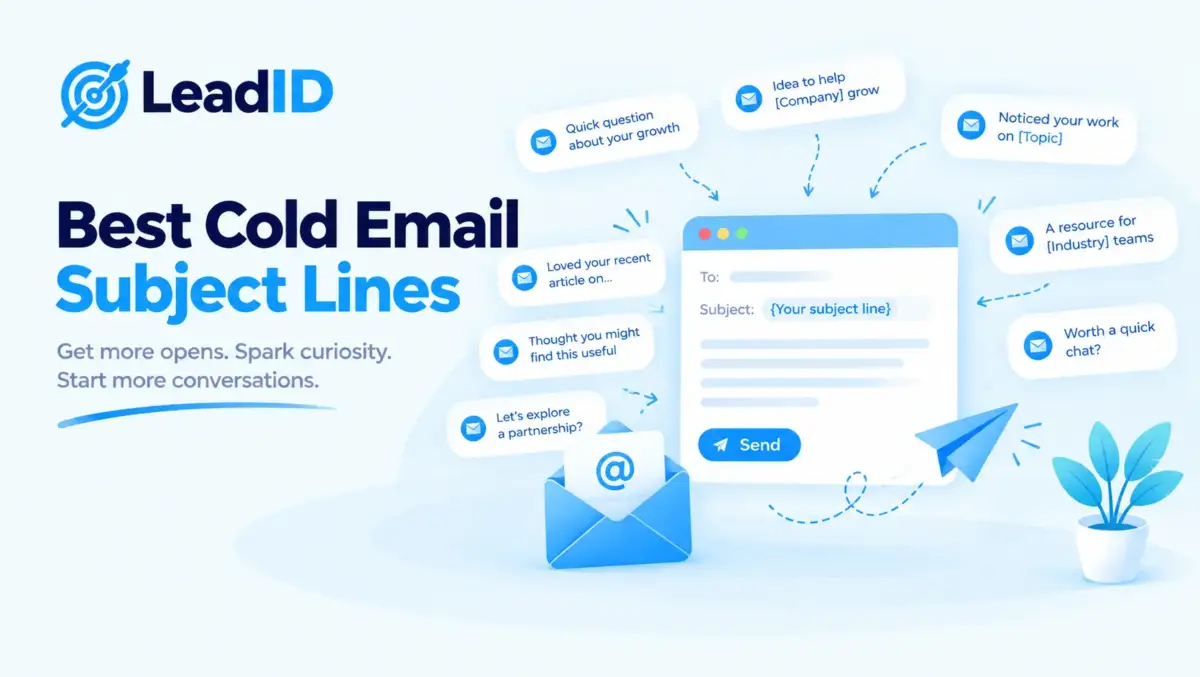
The best cold email subject lines are the only lines that decide whether a message gets opened at all. Everything you spent hours writing in the body is irrelevant if the first few words in the inbox do not earn a click. Median B2B cold email open rate sits around 26% (Woodpecker, 37,000 campaigns), and the gap between a well-written subject line and a bad one is 20 to 30 percentage points, which translates directly to pipeline.
What follows is a complete 2026 library of cold email subject lines that get opened: ten functional categories with fifty working examples, the writing rules that separate the top-quartile from the median, an A/B testing framework for your own, and the patterns to avoid because they trip spam filters or burn trust. Each category pairs with the right cold email software for sending, warming, and tracking which lines actually get opened.
Key Takeaways
- Cold email subject lines that get opened share three traits: they are short (3 to 7 words, under 40 characters), lowercase or sentence case (never ALL CAPS), and specific to the recipient rather than generic. Everything beyond that is category tuning.
- Personalization adds 11 points of open-rate lift on average (Belkins study: 46% personalized vs 35% generic). A single dynamic token referencing the recipient’s company, role, or recent activity beats every generic hook you can write.
- Judge subject lines by reply rate, not open rate. Apple Mail Privacy Protection inflates opens for roughly 55% to 62% of recipients; reply rate is the only metric that survives the filter and correlates with pipeline.
- Question-based subject lines clear 46% open rate, the highest of any category in Belkins’ 2024 B2B dataset. They work because they borrow the brain’s instinctive “answer this” reflex, but only when the question is genuinely specific to the recipient.
- Never fake a reply thread or a referral. “Re:” prefixes on first-touch sends, fabricated mutual connections, and false urgency all trip modern spam filters AND burn the credibility you need to earn the second meeting.
What Makes A Cold Email Subject Line Actually Get Opened
A subject line gets about 1.2 seconds of attention before the recipient decides to open, archive, or report. Three signals carry the decision in that window: who the sender appears to be, how relevant the subject looks to what the recipient does today, and whether the message pattern-matches to spam.
Length: the best cold email subject lines keep it short. Woodpecker’s data shows 10 to 19 character subject lines pull a 30% median open rate versus 23% at 60 to 69 characters. Reply.io’s analysis of 712,000 emails backs this up: 1 to 4 words beats everything above 8 words consistently. Mobile truncates past about 40 characters, so anything longer loses the back half of the message to a tooltip nobody reads.
Case: lowercase or sentence case reads as personal; ALL CAPS reads as spam. The top-performing B2B SaaS subject lines look like a note from a colleague, not a marketing email. “quick question about ACME’s expansion” beats “QUICK QUESTION ABOUT YOUR EXPANSION!!” by about 15 points on open rate.
Specificity: personalization beats hype every time. A subject line that references the recipient’s company, role, recent news, or product adds roughly 11 open-rate points over a generic one. Dynamic tokens pulled from LinkedIn or company news are the single highest-leverage tuning available.
10 Categories of Cold Email Subject Lines That Get Opened
Virtually every subject line in circulation falls into one of the ten categories below. Each one works for a specific intent; stacking two or three categories in rotation inside an outbound sequence (A/B/C testing) is how the best SDR teams compound their open rates over a quarter.
1- Curiosity-Driven
Subject lines that imply the body contains something worth knowing but hold back the full payload. Works because the brain treats open loops as uncomfortable and seeks closure. Over-use leads to clickbait fatigue.
- quick question about [Company]
- idea for [Company]’s [specific team]
- noticed something on your pricing page
- one thought on [recent initiative]
- [first name], quick one for you
2- Personalized Reference
Direct reference to something specific about the recipient’s company, role, or recent public activity. Highest-leverage category for B2B because specificity signals research, which signals credibility.
- loved your talk at [conference]
- [Company]’s new [product/feature] launch
- [first name], saw you hired a Head of RevOps
- your Series B announcement last week
- [Company]’s expansion into [market]
3- Mutual Connection or Referral
Lead with a real third party who connects you to the recipient. Must be genuine; fabricated connections burn trust immediately when the body cannot back the name up.
- [Mutual contact] suggested I reach out
- intro from [mutual connection]
- [Mutual] mentioned your [initiative]
- [first name], [mutual contact] from [company]
- following up on [mutual]’s intro
4- Specific Value Proposition
State the specific outcome the recipient could get, with a concrete number or percentage. Works when the benefit is quantified and credible for the recipient’s context.
- cut [metric] by 40% in a quarter
- 15% more pipeline for [Company]’s SDR team
- save your reps 6 hours a week
- double your reply rate on cold outbound
- 1 hour of your week, 10% more conversions
5- Question-Based
A direct question in the subject line. Belkins’ 2024 study puts this category at a 46% open rate, the highest in their B2B dataset. Works because the brain treats direct questions as needing an answer, even in a glance.
- who owns [specific process] at [Company]?
- worth a quick chat?
- are you still handling [function] in-house?
- how is [Company] tracking [metric] today?
- right person for [topic]?
6- Short or One-Word
The minimalist category. One to three words that look like a note from a colleague. Works best when sender name carries weight or the recipient is in-industry.
- quick one
- thoughts?
- [first name]?
- hey
- chat?
7- Pain Point Call-Out
Name the specific operational pain the recipient is likely facing. Works when the pain is real and current, which requires actual research into the recipient’s context.
- [Company]’s SDR deliverability is tanking
- spending too much on [tool]?
- the manual work in your [workflow]
- [Company]’s reply rate problem
- why [function] takes 3x longer than it should
8- Recent Trigger Event
Lead with a specific recent event at the target company (funding, hire, product launch, acquisition). Signals that the sender actually tracks the account.
- congrats on the Series B
- [Company] + [acquired company]
- [Company]’s new VP of Marketing
- [Company]’s expansion to [market]
- your product launch yesterday
9- Social Proof
Reference a company the recipient respects as a current customer. Only works when the reference company is genuinely known to the recipient and the body backs up the claim with a specific result.
- how [Named Peer Company] cut [metric] 30%
- what [Peer Company] figured out last quarter
- [Peer] uses this; worth 10 min?
- [Industry Leader]’s approach to [problem]
- three of your competitors just signed
10- Direct and Transparent
No hook, no curiosity, just a plain statement of what the email is about. Loses on open rate against the fancier categories but wins on trust with senior buyers who distrust marketing-sounding subjects.
- cold email about [specific topic]
- pitch: [product] for [Company]
- reaching out from [your company]
- 15 min on [specific topic]?
- intro from [your company]
5 Rules For Writing Cold Email Subject Lines That Get Opened
Run every subject line through these five rules before it ships. The rubric catches the issues that trip spam filters, burn trust, or just underperform on reply rate.
| RULE | WHAT TO DO |
|---|---|
| 1- Keep it under 40 characters | Mobile clients truncate past 40. Aim for 3 to 7 words, 20 to 35 characters. |
| 2- Lowercase or sentence case | Zero all-caps words except standard acronyms (SEO, CEO, API). Reads as personal. |
| 3- One dynamic token minimum | First name, company, recent event, or role. Personalization lifts open rate by about 11 points. |
| 4- No spam-trigger stacking | Never combine two spam categories (urgency + free, money + over-promising). See the spam words list for the full avoid set. |
| 5- No fake context | No “Re:” on first-touch, no invented referrals, no false urgency. Trips filters AND burns the second-meeting credibility. |
The rubric compresses to one sentence: short, personal, honest, specific. Every subject line that fails on any one of those four fails more often than it succeeds, regardless of how clever the hook is.
Subject Line A/B Testing Framework
Picking the right subject line for your audience is a measurement job, not a creative one. Every outbound program should run a structured A/B test on subject lines every two weeks, with the three-step framework below.
Step 1: Pick two categories to test. Not two subject lines; two categories. For example, question-based vs personalized reference. Running two versions of the same category wastes the test cycle.
Step 2: Send both to a matched sample. Split 500 to 1,000 recipients 50/50 across the two subject lines, with identical body copy. Smaller samples than 500 per arm produce too much noise to draw conclusions. Larger samples are better but take longer to run.
Step 3: Measure reply rate, not open rate. Open rate is corrupted by Apple Mail Privacy Protection. Positive reply rate (replies minus out-of-office and unsubscribes) is the ground-truth metric. The winning category becomes your default for the next cycle; the losing category gets retired or re-tested with a new wording angle next quarter.
Cold Email Subject Lines To Avoid
Five subject-line patterns reliably fail in B2B cold outreach, either by tripping spam filters, burning trust, or just producing low reply rates. Avoid these regardless of category or industry.
- Fake “Re:” or “Fwd:” prefixes. On a first-touch email, both scream deception. Modern Gmail and Outlook filters flag these as high-risk, and recipients who open them lose trust before the first line of body copy.
- ALL CAPS WORDS. “FREE”, “URGENT”, “ACT NOW” trip the formatting-signal layer regardless of the surrounding words. One all-caps standard acronym (SEO, API) is fine; a whole word in caps is a spam flag.
- Multiple exclamation points. One exclamation can work for the right tone. Two or more read as marketing-shouty and reduce open rate by about 10 points on cold audiences.
- Fabricated urgency. “Last chance today” when nothing is actually expiring, or “limited availability” when supply is unlimited. Recipients spot the pattern and the second-touch credibility is already gone.
- Generic marketing lead-ins. “Boost your sales with us”, “Transform your business today”, “Supercharge your [X]”. Zero signal that the sender knows anything specific about the recipient.
When Even Perfect Subject Lines Cannot Reach The Inbox
Every cold outreach program carries a baseline of unreachable accounts. Inbox placement sits around 80% to 90% on a well-warmed sender, which means 10% to 20% of your target list never sees your subject line, no matter how well crafted. Role-based inboxes (info@, sales@, contact@) go to shared mailboxes nobody opens. Spam-filtered domains quietly swallow the message. For those accounts, the second lane that actually works is the prospect’s own “Contact Us” form.
ContactID is the Chrome extension purpose-built for this parallel channel. It detects the contact form on any target domain, fills every field, solves reCAPTCHA v3 and hCaptcha at a reported 99.9% success rate, personalizes the message with a snippet from the target page, and submits in bulk. Pricing is strictly pay-per-success: $0.15 per landed submission on pay-as-you-go, dropping to $0.01 per site at the Scale tier. SDR teams layering ContactID on top of standard cold email see a 20% to 40% lift in in-month opportunities because the two channels reach different inbox routes.
Who it is for: SDR teams, agencies, and founder-led sales who want the accounts their cold email cannot reach. Pay only when a form is found, filled, and submitted; no inbox warmup, no deliverability maintenance, no monthly commitment required.
Bottom Line
The best cold email subject lines that get opened share four traits: short (3 to 7 words), lowercase or sentence case, personalized with at least one dynamic token, and honest about what the message is. Pick the category that fits your intent from the ten above, run an A/B test every two weeks measured by reply rate, and avoid the five patterns that reliably fail.
The gap between a top-quartile subject line and a bad one is 20 to 30 open-rate points, which is the difference between a program that books meetings and one that fills the spam folder. Pair clean subject-line discipline with the full cold email templates library for body copy and a disciplined cold email outreach sequence for follow-ups, and the outbound engine compounds every quarter.
FAQs
1- What are the best cold email subject lines in 2026?
Short, lowercase, personalized subject lines consistently outperform. The highest-converting category is question-based (46% open rate per Belkins), followed by cold email personalization that references a specific trigger (46% personalized vs 35% generic), mutual connection, and recent trigger event. Pick the category that fits your intent and A/B test two of them every two weeks.
2- How long should a subject line be?
3 to 7 words, 20 to 40 characters. Woodpecker data shows 10-19 character lines pull 30% open rate vs 23% at 60-69 characters. Mobile clients truncate past 40 characters, so anything longer loses the back half. Short + specific wins; long + generic loses.
3- Do subject lines really affect open rate that much?
Yes. The gap between a top-quartile subject line and a bad one is 20 to 30 percentage points of open rate. Median B2B cold email open rate sits around 26% (Woodpecker, 37,000 campaigns); a strong subject line clears 40%+; a weak one lands under 15%. Nothing else in the email matters more.
4- Should I use emojis in subject lines?
Not in cold B2B outreach. Emojis read as consumer marketing, which lowers trust with senior buyers. They also trigger the formatting-signal layer in spam filters when more than one appears. For warm emails to known contacts, one well-placed emoji can lift opens; for cold outbound, skip them entirely.
5- Is it OK to use “Re:” in a subject line?
No, on first-touch cold emails. Fake “Re:” prefixes were a popular spam tactic in 2018, and modern Gmail and Outlook filters penalize them heavily. Recipients who open the message lose trust immediately. Use “Re:” only on genuine replies in an actual existing thread.
6- What is the best way to personalize a subject line?
One dynamic token referencing the recipient’s company, role, or recent public activity. First name alone is weak personalization because everyone does it; “[Company]’s expansion to [market]” or “your Series B last week” signal actual research. Belkins’ study shows personalized subjects open at 46% vs 35% for generic.
7- Which category of subject lines works best for B2B SaaS?
Personalized reference and question-based consistently top the leaderboard for B2B SaaS cold outreach. Both work because they signal specific research and invite a direct response. Short lowercase variants (“quick question about [Company]”) read as colleague-to-colleague and clear 35%+ reply engagement on well-targeted lists.
8- How do I test subject lines without burning my sender reputation?
Split 500 to 1,000 recipients 50/50 across two subject-line categories (not two subject lines in the same category), keep body copy identical, and measure positive reply rate rather than open rate. Smaller samples produce too much noise. Run one test cycle every two weeks to let reputation stabilize between experiments.
9- Why is my cold email open rate so low even with good subject lines?
The subject line is only one of five scoring layers. If sender reputation, DNS authentication (SPF, DKIM, DMARC), or warmup are weak, even perfect subject lines land in spam. Diagnose by checking inbox placement rate first; if below 80%, fix the sender fundamentals before iterating on subject-line copy.
10- Should the subject line match the body copy?
Yes, closely. The subject line sets an expectation, and the first sentence of the body must deliver on it inside 10 seconds of reading. Mismatched subject and body is the single biggest source of unsubscribes on cold outbound: recipients feel baited, mark as spam, and the sender reputation damage compounds across future sends.



Pingback: Cold Email Outreach in 2026: Process, Tips, and Mistakes to Avoid
Pingback: Spam Words in 2026: 50 Email Spam Trigger Words to Avoid in Subject Lines
Pingback: Cold Email Follow Up in 2026: 5-Step Sequence That Wins Replies
Pingback: Cold Email Personalization: 7 Signal Tiers for 2026