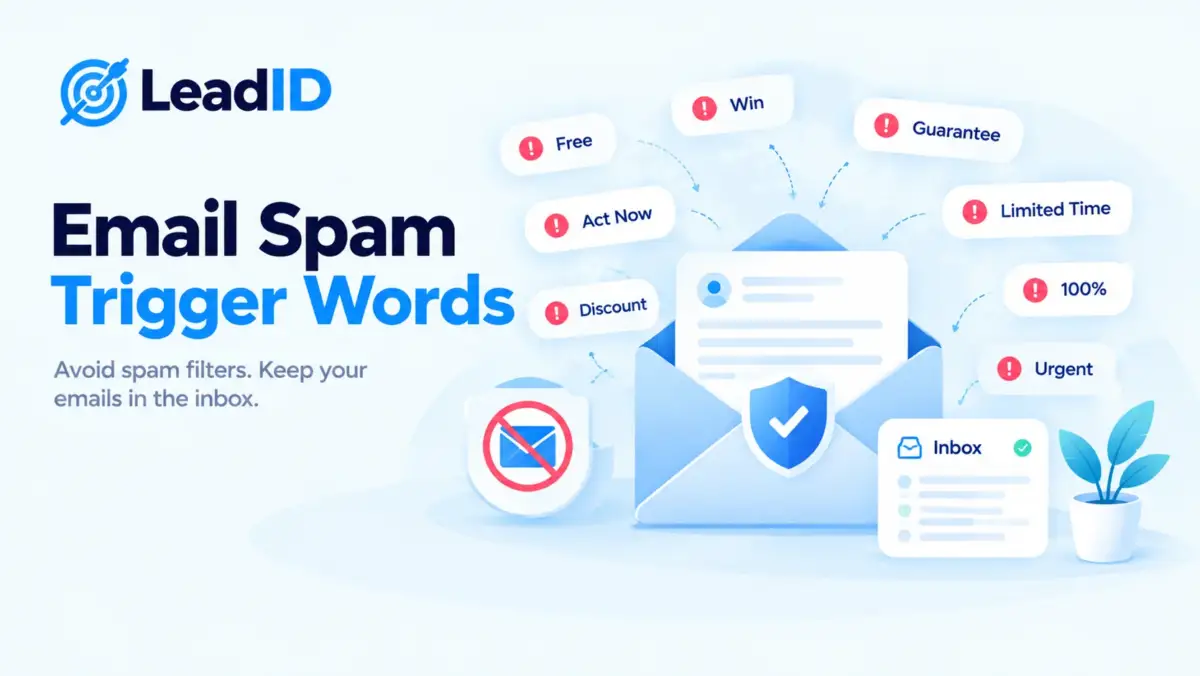
Spam words are the specific terms, phrases, and formatting patterns that modern inbox filters flag as risk signals. Words like “free money”, “act now”, “click here”, and “verify your account” sit near the top of every spam filter’s suspicion list because they correlate with decades of actual spam and phishing campaigns. Use enough of them in a subject line or body, and your message routes to the spam folder before any human sees it.
What follows is the complete 2026 reference for spam words: seven categories of email spam trigger words, a 50-word avoid list, safer alternatives that still convert, how modern Gmail and Outlook filters actually score your email, and a 5-point subject-line rubric that keeps you in the primary inbox. For teams running outbound at scale, spam-word discipline sits inside the broader cold email deliverability stack that decides whether campaigns land or burn.
Key Takeaways
- Spam words rarely send an email to the spam folder on their own in 2026. Modern Gmail and Outlook filters weigh sender reputation, SPF/DKIM/DMARC authentication, and recipient engagement far more heavily than word matches, but spam words still push the score the wrong way when combined with any of the other weak signals.
- Seven categories cover almost every spam trigger word: money and finance, urgency, free and discount, scammy framing, over-promising claims, health and weight loss, and shouty formatting (all caps, excessive exclamation). Avoid stacking two or more categories in one subject line.
- Phishing-style words carry the heaviest penalty: “verify your account”, “confirm your identity”, “update your billing”, and “unusual activity detected” trigger immediate flags because the content signature matches real phishing campaigns Gmail trains against daily.
- Formatting matters as much as word choice. ALL CAPS subject lines, three or more exclamation points, dollar signs in sequence ($$$), and heavy emoji use trigger spam heuristics even when every individual word is safe. Normal-case subject lines with one specific benefit beat shouty attention-grabbers on both filter score and open rate.
- Safe alternatives always exist. “Save 50%” becomes “cut 50% off”, “Act Now” becomes “available through Friday”, “FREE trial” becomes “complimentary access”. The intent survives; the filter penalty does not.
Why Spam Words Still Matter In 2026
A decade ago, spam filters were mostly rule-based. SpamAssassin and its peers assigned point values to suspicious words and routed any email above a threshold score straight to spam. Fixing deliverability was largely a matter of word substitution.
Modern filters at Gmail, Outlook, and Yahoo are machine-learning systems trained on billions of user feedback signals (opens, replies, “mark as spam” clicks, “not spam” rescues). The word list still exists inside those models, but it is one of hundreds of input features rather than the primary gate.
That shift confuses the picture. A single spam word in a subject line rarely sinks a message when the sender has a clean reputation and strong engagement history. The same word in an email from a new mailbox with weak authentication tips the entire message into spam.
The practical rule in 2026: these words are risk amplifiers, not stand-alone killers. Avoid them anyway, because every email you send carries some combination of other weak signals (a new recipient relationship, an unfamiliar link, a cold send pattern), and the spam-word penalty always stacks on top.
How Modern Spam Filters Actually Score Your Email
Every major inbox provider runs a layered scoring process. Spam words are evaluated in step three, after two more consequential checks have already run.
| STEP | WHAT IT CHECKS | WEIGHT |
|---|---|---|
| 1. Authentication | SPF pass, DKIM signature valid, DMARC alignment with From domain. | Hardest gate. Fail here, nothing else matters. |
| 2. Sender Reputation | IP reputation, domain age, prior spam complaints, bounce rate, volume history. | Heaviest ongoing input to score. |
| 3. Content Analysis | Trigger keywords, suspicious links, image-to-text ratio, formatting patterns (caps, punctuation, emoji). | Moderate weight; amplifies the first two. |
| 4. Recipient Engagement | Historical open rate, reply rate, folder-move actions by this recipient. | Per-recipient personalized layer. |
| 5. Behavioral Pattern | Send velocity, time-of-day, list pattern similarity to known spam campaigns. | Last-mile anti-spam tuning. |
The sequence matters. If authentication fails at step one, the message often does not even reach content analysis. If sender reputation is strong at step two, moderate spam-word use at step three may still clear the inbox. The best outcome happens when all five steps lean positive together.
7 Categories Of Email Spam Trigger Words
Virtually every email spam trigger word in circulation falls into one of the seven categories below. Learning the categories matters more than memorizing specific words, because filters update the exact word lists quarterly while the category heuristics stay stable.
1- Money and Finance
Any word that signals cash incentive, prize, or financial windfall. Classic examples: cash, money, payout, cash bonus, cash prize, million dollars, extra cash, make money, earn extra, serious cash, double your income, pure profit, hidden assets, financial freedom.
Why it triggers: historically correlated with lottery scams, Nigerian-prince patterns, and pyramid schemes. Even legitimate finance senders dial these back because the category score penalty is heavy.
2- Urgency and Pressure
Words that pressure the reader to act immediately. Common examples: act now, hurry, urgent, limited time, don’t delay, expires today, last chance, final notice, limited offer, time running out, immediate action required.
Why it triggers: urgency wording is the single most common pattern in phishing emails. Filters treat it as a reliable signal of intent to manipulate rather than inform.
3- Free and Discount
Any word promising something at no cost or at an extreme discount. Common examples: free, 100% free, free trial, free money, free offer, free gift, free consultation, free sample, free access, no cost, no fees, zero risk, risk-free.
Why it triggers: “free” in subject lines was the single most-used spam term for over a decade. Modern filters have detuned the penalty slightly (legitimate marketers use it constantly), but ALL-CAPS “FREE” still trips the formatting layer.
4- Scammy and Dishonest
Phishing-adjacent phrases that mirror scam patterns. Highest-penalty category. Examples: verify your account, confirm your identity, update your billing, unusual activity, your account has been compromised, click here to secure, dear friend, dear valued customer, this is not spam, this is not a scam.
Why it triggers: these phrases match active phishing templates Gmail trains against daily. Any legitimate sender using them inherits the full phishing penalty. Avoid them even in body copy, not just subject lines.
5- Over-Promising
Words that make big, specific, unverifiable claims. Common examples: guaranteed, 100% satisfied, best price ever, lowest price, lowest rate, no catch, no obligation, no questions asked, can’t live without, you won’t believe, this changes everything, miraculous results.
Why it triggers: real senders rarely use absolutes because they do not actually deliver absolute results. Filters know this and treat over-promising language as a scam signal.
6- Health and Weight Loss
Regulatory-risk words from the health, pharma, and supplement verticals. Common examples: lose weight, weight loss, diet pills, cure, anti-aging, miracle cure, no prescription, cheap meds, Viagra, pharmaceutical, prescription-free, body fat.
Why it triggers: health claims face both spam filtering and separate regulatory review (FDA, FTC). Filters apply extra scrutiny to this entire vertical. Even legitimate health senders have to carefully reword.
7- Shouting (Formatting Patterns)
Not individual words, but formatting choices that filters read as spam signals. ALL CAPS subject lines or body phrases, three or more exclamation points, dollar signs in sequence ($$$), red font color, oversized text, excessive emoji (more than two in a subject line).
Why it triggers: spammers used shouting formatting for a decade to grab attention from scanning readers. Filters now treat it as reliable spam signature regardless of word content.
50 Words Not To Use In Email Subject Lines
The table below is the working short-list of words and phrases to avoid in cold email subject lines, grouped by the category each one belongs to. Avoiding every one of these is not realistic for every sender; the goal is to never stack two from different categories in the same subject line.
| CATEGORY | WORDS TO AVOID |
|---|---|
| Money | cash, make money, earn extra, extra cash, million dollars, cash bonus, cash prize, financial freedom, hidden assets |
| Urgency | act now, hurry, urgent, don’t delay, expires today, last chance, final notice, immediate action, time running out |
| Free | free, FREE, free money, free gift, free offer, free trial, 100% free, zero cost, no fees |
| Scammy | verify your account, confirm your identity, update your billing, unusual activity, dear friend, dear valued customer, this is not spam, click here to secure |
| Over-promising | guaranteed, 100% satisfied, no catch, no obligation, you won’t believe, miraculous, changes everything, lowest price ever |
| Health | lose weight, weight loss, miracle cure, anti-aging, diet pills, Viagra, no prescription, body fat |
Note that no single word on this list is an automatic spam folder. Many legitimate senders use “free trial” or “limited time” in subject lines every day without landing in spam. The pattern that fails is combinations: “FREE Limited-Time Offer! Act Now!” ticks four categories simultaneously, which no sender reputation recovers from.
Safe Alternatives That Don’t Trigger Spam Filters
Most spam filter keywords have a direct safe equivalent that preserves the commercial intent without the filter penalty. The table below lists the swaps that work best in subject lines across every major provider.
| SPAM TRIGGER | SAFE ALTERNATIVE |
|---|---|
| FREE trial | Complimentary access / no-cost trial |
| Act now | Available through Friday / book a slot |
| Save 50% | Cut 50% off / half your current spend |
| Make money | Grow revenue / build pipeline |
| Guaranteed results | Case study outcomes / typical results |
| Click here | See the full breakdown / view the demo |
| Limited time offer | Available this quarter / ends month-end |
| Dear friend | Hi [first name] / Good morning [first name] |
| Lose weight fast | Change your routine in 90 days |
| You’ve been selected | Based on your [industry/role], this fits |
The pattern across every swap: specificity replaces hype. “Complimentary 14-day access” beats “FREE trial” because the specificity signals a real offer, and filters trained on billions of emails have learned that specific-and-measured correlates with legitimate sender, hype-and-vague correlates with spam.
5-Point Subject Line Rubric For Primary Inbox Placement
Run every subject line through this five-point check before sending. If any single check fails, rewrite. The rubric below catches 90%+ of the subject-line issues that trip modern spam filters.
- 1. Zero all-caps words except a legitimate acronym (SEO, CEO, KPI). “FREE”, “URGENT”, “ACT NOW” all fail.
- 2. One exclamation point maximum, and only when it genuinely fits the message tone. Zero is better than one.
- 3. No stacked categories. Subject lines that combine two or more of the seven spam-word categories (urgency + free, money + over-promising) fail. One category at most, used sparingly.
- 4. Zero phishing-adjacent phrases. No “verify”, “confirm your identity”, “unusual activity”, “update billing” even in body copy. These trip the highest-penalty filter layer.
- 5. Specific benefit over vague promise. “Cut your cold email cost by 40%” beats “Save Money On Email!” every time, both at the filter and at the open rate.
The rubric compresses to a one-line test: specific, calm, and never shouting. Subject lines that pass all five points land in primary inbox at well above the 25% to 35% engagement benchmarks tracked across the standard email marketing kpis.
Common Spam Word Mistakes In Cold Outreach
Five mistakes account for most of the spam-folder landings in cold outreach specifically. All five are preventable with disciplined subject-line review before any campaign goes live.
- Treating spam words as the only variable. A spotless subject line will still land in spam if the sender has weak reputation. Fix authentication and warmup first; worry about word choice second. The full email warmup ramp protects reputation before any cold send begins.
- Copying a competitor’s subject line verbatim. A phrase that works for an established sender with great reputation often lands a new sender in spam. The same words carry different filter weights depending on who sends them.
- Stacking categories to maximize appeal. “FREE 14-Day Trial! Act Now Before It Expires!” combines free, urgency, and shouting formatting in one line. Each piece alone might survive; three stacked guarantees spam folder.
- Hiding triggers in preview text. Modern filters scan the preview text (first 90 to 120 characters of the body) with the same word list as the subject line. Trigger terms moved from subject to preview trip the same flags.
- Using “Re:” or “Fwd:” when there is no real thread. Fake reply prefixes were a popular spam tactic in 2018 and filters now penalize them heavily. Use them only when the subject actually continues a real conversation.
Bottom Line
Spam words in 2026 are risk amplifiers, not stand-alone killers. Avoid the seven categories above (money, urgency, free, scammy, over-promising, health, and shouting formatting), never stack two categories in one subject line, and swap every trigger for the specific-and-measured alternative that preserves commercial intent without the filter penalty.
Pair clean word choice with proper authentication, a warmed sender, and a healthy engagement history, and the primary inbox opens up at a 90%+ placement rate even on cold outreach. Clean copy without the deliverability fundamentals still fails; strong fundamentals with messy copy survive longer than most senders expect.
FAQs
1- What are spam words in email marketing?
Spam words are specific terms, phrases, and formatting patterns that modern inbox filters flag as risk signals. They include money terms (cash, make money), urgency language (act now, hurry), free offers (FREE, no cost), phishing-adjacent phrases (verify your account), over-promising claims (guaranteed, miraculous), and shouty formatting (ALL CAPS, excessive exclamation points).
2- Do spam words still matter if filters are machine-learning now?
Yes, but less than they did a decade ago. Modern Gmail and Outlook filters weigh sender reputation, authentication, and recipient engagement far more heavily than word matches. Trigger phrases still push your score the wrong way when combined with any weak signal, so avoid them anyway.
3- What are the worst words that trigger spam filters?
Phishing-adjacent phrases carry the heaviest penalty: “verify your account”, “confirm your identity”, “update your billing”, “unusual activity detected”, “click here to secure”. These match active phishing templates filters train against daily, so legitimate senders inherit the full phishing penalty when using them.
4- What words should I not use in email subject lines?
The 50 highest-risk words to avoid in email subject lines fall into seven categories: money (cash, make money, million dollars), urgency (act now, hurry, expires today), free (FREE, no cost, zero fees), scammy (verify your account, dear friend, this is not spam), over-promising (guaranteed, miraculous, you won’t believe), health (lose weight, miracle cure, Viagra), and shouting formatting (ALL CAPS, multiple exclamation points, dollar signs).
5- Can I use the word “free” in a subject line?
Yes, if used sparingly and in lowercase. “Free” in normal case with no other spam categories stacked (urgency, over-promising, shouting) usually survives modern filters, especially for senders with strong reputation. “FREE Trial! Act Now!” fails. “Free guide to Q4 planning” usually passes.
6- Do emojis in subject lines count as spam filter keywords?
Not individual emoji, but excessive use (three or more in one subject line) triggers the shouting-formatting layer. One emoji in a subject line is usually fine; three or more reads as attention-grabbing spam signature to filters. The specific emoji also matters: money bag (💰), fire (🔥), and warning (⚠️) raise flags faster than neutral emoji like calendar (📅) or lightbulb (💡).
7- How do I test my email for spam trigger words?
Free tools: Mail Tester (mail-tester.com), ISnotSPAM, and GlockApps all score an email against common spam-word lists and authentication checks. Scores above 8/10 on Mail Tester usually indicate clean copy. Note that scores reflect content only; they do not predict actual inbox placement, which depends on sender reputation too.
8- Does ALL CAPS in a subject line always trigger spam?
A single all-caps acronym (SEO, CEO, API) does not trigger the shouting filter. A whole word in all-caps (FREE, URGENT, ACT NOW) does, especially combined with exclamation points. The safest rule: zero all-caps words in a subject line unless they are standard acronyms.
9- Are spam words the same across Gmail, Outlook, and Yahoo?
The categories overlap heavily (all three penalize phishing-adjacent phrases, urgency language, over-promising) but the exact weight each provider assigns to specific words differs. Outlook historically has been stricter on health and pharma terms, Gmail stricter on phishing templates, Yahoo stricter on volume plus content stacking. Clean copy across all three categories keeps you safe across all providers.
10- What if my product actually is a “free trial” of a “limited time offer”?
Use specific-and-measured phrasing instead. “Complimentary 14-day access” beats “FREE Trial”. “Available through October 31” beats “Limited Time Offer”. The commercial intent survives; the filter penalty does not. Legitimate marketers describe real limited-time offers every day without landing in spam by using precise, calm, benefit-first phrasing.


Pingback: Cold Email Deliverability 2026: Why It Drops and How to Fix It
Pingback: Email Warmup in 2026: 30-Day Schedule, Tools, and Deliverability Rules
Pingback: 50 Cold Email Subject Lines That Get Opened in 2026 (By Category + Examples)