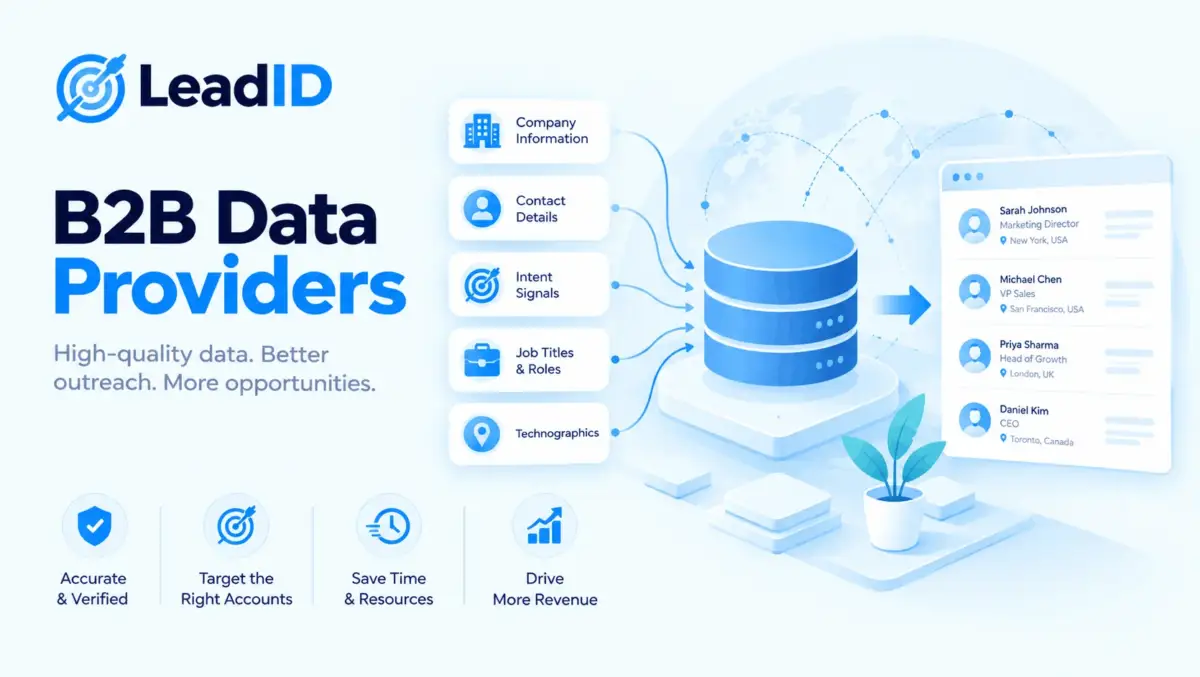
Every outbound campaign is only as good as the list behind it, which is why B2B data providers are the first tool most sales and marketing teams buy. The catch is that the category now spans three different jobs: contact and company data, buying intent data, and the outreach that turns a record into a reply. Picking the wrong type wastes budget on data you cannot act on. This comparison ranks the best b2b data providers for each job, with real pricing, accuracy notes, and where each one actually fits.
The honest headline is that no single vendor wins everything. ZoomInfo owns US data depth, Cognism owns European phone data, Apollo owns value, and the intent platforms play a different game entirely. If your real goal is booked meetings rather than a bigger spreadsheet, it also pays to look past the pure databases to tools that pair data with outreach, which is where this guide fits alongside the broader category of sales prospecting tools. Below is the full breakdown.
Key Takeaways
What B2B Data Providers Actually Sell
B2B data providers answer one question: who should you contact, and how do you reach them. The category divides into three jobs, and most teams need at least two of them.
Contact and Company Data
This is the core: verified business emails, direct-dial phone numbers, job titles, and firmographics like company size, revenue, and tech stack. ZoomInfo, Apollo, Cognism, Lusha, and Seamless.AI all compete here, and this is what most people mean by b2b leads data providers.
Intent and Buying Signals
Intent data shows which accounts are researching a topic right now, so you can prioritize the ones already in-market. Bombora, 6sense, and Demandbase lead this layer, and it is a separate budget line from a contact database.
Data Plus Outreach
The newest category closes the loop by acting on the data for you. contactID supplies the contacts and then submits your pitch through each company’s website contact form, so the record becomes an actual touch rather than a row you still have to work.
B2B Data Providers Compared
Here is the at-a-glance view of the top b2b data providers before the detailed breakdowns. Entry prices are the lowest meaningful tier, verified against each vendor in 2026.
| Provider | Best For | Data Type | Entry Price |
|---|---|---|---|
| ZoomInfo | Enterprise US outbound | Contact, company, intent | ~$15,000/yr |
| Apollo | Best value, data plus sending | Contact, company | Free, paid from ~$49/user/mo |
| Cognism | European, phone-verified data | Contact, company, intent | Custom, ~$15,000/yr |
| Lusha | Simple self-serve prospecting | Contact, company | Free, paid from ~$30/user/mo |
| Clay | Waterfall enrichment at scale | Orchestration (100+ sources) | From $149/mo |
| Seamless.AI | Real-time lead search | Contact, company | ~$147/mo (quote-based) |
| contactID | Turning data into outreach | Contact, company + outreach | $9.99/mo + $0.15/site |
7 Best B2B Data Providers for Contact and Company Data
These are the providers that supply the contacts and firmographics your campaigns and ideal customer profile filters run on, ranked by where each one leads rather than by a single score.
1. ZoomInfo
ZoomInfo is the most comprehensive B2B data provider on the market and the default for enterprise go-to-market teams. It combines deep contact and company records with buying intent, scoops, and org charts, all built on what it calls the world’s best B2B data. If your motion is US-heavy and you need breadth above all, nothing matches its database.

Pricing is enterprise and opaque. There is no free plan, contracts are annual, and the most-cited floor is around $15,000 a year, with one purchasing dataset putting the median near $33,500. Independent testing has put its email match rate near 84 percent, the highest in a recent head-to-head.
Standout: Unmatched US data depth with intent, scoops, and org charts bundled in, which is why large teams standardize on it despite the cost. Its accuracy and pricing tradeoffs are examined in full in the ZoomInfo review.
Watch for: The price and annual commitment put it out of reach for most small teams, and the platform is far more than a solo rep or lean startup needs.
| Pros | Cons |
|---|---|
| ✓ Deepest US contact and company data | ✗ Expensive, annual contracts only |
| ✓ Intent and scoops built in | ✗ No free plan or self-serve tier |
| ✓ Strong accuracy in testing | ✗ Overkill for small teams |
2. Apollo
Apollo is the best-value pick and the one most small and mid-sized teams land on. It pairs a large contact database with built-in sequencing, so you can find a prospect and email them in the same tool. That all-in-one design is why it shows up on nearly every shortlist of b2b leads data providers.

It offers a genuine free tier, with paid plans from about $49 to $119 per user each month on annual billing. The tradeoff is accuracy: independent testing put its email match near 78 percent, a step below ZoomInfo, so pair it with verification for cold sending.
Standout: The strongest value in the category, with data and outreach in a single affordable platform. Its data accuracy and deliverability tradeoffs are examined in the Apollo review.
Watch for: Data accuracy trails the enterprise databases, and per-seat pricing adds up quickly once a team grows.
| Pros | Cons |
|---|---|
| ✓ Best value, free tier available | ✗ Accuracy below ZoomInfo and Cognism |
| ✓ Data plus sequencing in one tool | ✗ Per-seat costs climb with team size |
| ✓ Self-serve, fast to start | ✗ Verification needed for clean sending |
3. Cognism
Cognism is the go-to for European outbound and anywhere phone-verified, compliant data matters. Its Diamond Data is human-verified for accuracy, and its GDPR and CCPA posture makes it the safer choice for EMEA calling. For teams whose pipeline lives outside the US, it is often the strongest B2B data provider available. Its compliance claims and real match rates are put to the test in the Cognism review.

Pricing is custom with no public free plan, and estimates put it near $15,000 a year and up on annual-only contracts. Reviewers rate its valid-data rates in the same band as ZoomInfo, with European phone coverage as its clear edge.
Standout: Phone-verified Diamond Data and strong compliance make it the best fit for European, call-led outbound.
Watch for: No self-serve or free option, annual contracts, and US contact depth that still sits behind ZoomInfo.
| Pros | Cons |
|---|---|
| ✓ Best European, phone-verified data | ✗ Custom pricing, no free plan |
| ✓ Strong GDPR and CCPA compliance | ✗ Annual contracts only |
| ✓ High valid-data rates | ✗ US depth behind ZoomInfo |
4. Lusha
Lusha is the easiest B2B data provider to start with, built around a Chrome extension that reveals contact details as you browse LinkedIn or a company site. It advertises more than 515 million verified contacts and 29 million companies, and it suits individual reps and small teams who want data without a sales call.

It runs on credits with a free plan of roughly 40 to 70 credits a month, Pro from about $30 per user, and Premium near $70. That credit model is friendly for low volume but gets limiting fast once prospecting scales.
Standout: The lowest-friction way to pull verified contacts, with a self-serve free plan to test it. The credit economics are broken down in the Lusha review.
Watch for: Credit caps limit heavy prospecting, and database depth sits below the enterprise providers.
| Pros | Cons |
|---|---|
| ✓ Easiest to start, free plan | ✗ Credit caps limit volume |
| ✓ Clean Chrome extension workflow | ✗ Depth below enterprise databases |
| ✓ Transparent self-serve pricing | ✗ Fewer advanced filters |
5. Clay
Clay is not a database, it is the layer that orchestrates every other B2B data provider. It runs waterfall enrichment across more than a hundred sources, so when one provider misses an email, it falls through to the next until it finds one, then runs agentic workflows on top. For data teams that want coverage and control, it is in a class of its own.

Pricing starts at $149 a month and scales with credits, and power users routinely spend far more as workflows grow. It also assumes you bring your own provider keys or buy credits for them, so the platform fee is only part of the cost.
Standout: Waterfall enrichment across many providers delivers the highest achievable coverage from one place.
Watch for: A real learning curve and costs that climb with usage, since it is infrastructure rather than a plug-and-play database.
| Pros | Cons |
|---|---|
| ✓ Waterfall enrichment across 100+ sources | ✗ Steep learning curve |
| ✓ Agentic workflows and automation | ✗ Costs climb quickly with usage |
| ✓ Highest achievable data coverage | ✗ Needs your own provider credits |
6. Seamless.AI
Seamless.AI is a real-time search engine for leads rather than a static database. It builds and verifies contact records at the moment you search, which keeps data fresh, and it layers on automated outreach features. It is a fair fit for teams that value freshness and a self-serve entry point.

It does not publish pricing. Estimates put the entry near $147 a month on annual billing with monthly credit caps, and higher tiers are quote-only. Credits and renewal terms are a common point of friction in reviews, so read the contract before committing.
Standout: Real-time search and verification keep records fresh instead of relying on a periodic database refresh.
Watch for: Opaque pricing, credit limits, and reviews that flag aggressive sales and renewal tactics.
| Pros | Cons |
|---|---|
| ✓ Real-time search and verification | ✗ Pricing not published |
| ✓ Self-serve entry point | ✗ Credit caps on lower tiers |
| ✓ Built-in outreach features | ✗ Mixed reviews on sales and renewals |
7. contactID
contactID is the B2B data provider for teams who care about meetings, not just records. Its Find Websites lead finder builds a target list from a plain description of who you want and supplies the business emails, company websites, and firmographics behind it. Then it does what no database on this list does: it reaches those companies for you.

Its contact form automation opens each company’s website, finds the “Contact Us” form, fills it, clears pop-ups and the CAPTCHA, and submits your message. There is no sending domain to warm and no inbox deliverability to lose, because the message arrives through the form the company monitors.
Pricing is the sharpest contrast with the enterprise databases. It starts with ten free websites, runs pay-as-you-go at about fifteen cents per site, and scales on plans from $9.99 to $199.99 a month. You pay only on a confirmed send, so budget tracks real delivery instead of seats or annual minimums.
Standout: It is the only option here that supplies the data and acts on it, on a pay-per-success model with no deliverability limits. The full workflow is covered in the contactID review.
Watch for: Outreach lands through contact forms rather than a direct inbox, and it is newer than the enterprise databases, so it complements a traditional database as much as it replaces one.
Try contactID Free, Pay Only On Success
Best B2B Intent Data Providers
If your gap is timing rather than contacts, you need a different layer. The best b2b intent data providers tell you which accounts are researching your category right now, so you can reach them while they are in-market. These are sold separately from contact databases, and the enterprise ones are a serious budget commitment.
| Provider | Signal Type | Best For |
|---|---|---|
| Bombora | Third-party topic surge | Category-level reach across many topics |
| 6sense | Predictive, de-anonymized | Committed ABM with account scoring |
| Demandbase | Intent plus ad activation | ABM orchestration and advertising |
| G2 Buyer Intent | Review-site activity | Software sellers watching comparisons |
Bombora is the third-party intent standard. It runs the largest consent-based co-op, drawing surge signals from thousands of publisher sites across more than twenty thousand topics, and its data is often resold inside other tools, including ZoomInfo. It is best when you want broad, account-level reach rather than named contacts.
6sense is a predictive ABM platform that blends third-party intent, website de-anonymization, and predictive models to score accounts by buying stage. It fits teams running a committed account-based motion, and enterprise ABM pricing can run from roughly $50,000 a year upward.
Demandbase pairs intent with ABM orchestration and B2B advertising, so you can spot in-market accounts and activate against them in ad campaigns. It overlaps with 6sense and suits marketing-led ABM programs.
G2 Buyer Intent is the review-platform option. It shows which accounts are comparing you against competitors across G2, Capterra, Software Advice, and GetApp, which makes it the sharpest signal for software sellers specifically.
How to Choose B2B Data Providers
Start with the job, not the brand. The right provider follows from your territory, your budget, and whether your bottleneck is contacts, timing, or actually reaching people. Developer and RevOps teams that prefer pulling data through an API can weigh an API-first option in the Enrich review.
| Your Situation | Best Fit |
|---|---|
| Enterprise US outbound, budget available | ZoomInfo |
| Small or mid team wanting value | Apollo or Lusha |
| European, phone-led outbound | Cognism |
| Data team wanting maximum coverage | Clay |
| Timing-led, account-based motion | Bombora, 6sense, Demandbase |
| Want data that turns into meetings | contactID |
Then stress-test three things before you sign. Confirm accuracy for your specific region, since no provider clears one hundred percent and a verification step still pays for itself. Model the real cost at your team size, because per-seat and annual-minimum pricing behave very differently from pay-per-use. And decide whether you are buying a list or an outcome, because a database still leaves the outreach, and the deliverability that comes with it, entirely up to you. Teams that feed that data into cold email software or into contact-form outreach close that final gap.
Bottom Line
The best b2b data providers are not interchangeable. ZoomInfo wins on US depth, Cognism on European phone data, Apollo on value, Lusha on ease, Clay on coverage, and the intent platforms on timing. Match the provider to your territory and budget, add a verification step, and remember that a cleaner spreadsheet is not the goal. If you want data that becomes pipeline rather than a list you still have to work, contactID supplies the contacts and reaches them for you on a pay-per-success model, which is the shortest path from a record to a reply.
FAQs
1- What are the best b2b data providers in 2026?
ZoomInfo leads on US contact and company depth, Cognism on European phone-verified data, Apollo on value, and Lusha on ease of use. Clay is best for waterfall enrichment across many sources, and contactID is best for turning data into outreach. The right pick depends on your territory and budget.
2- How much do b2b data providers cost?
Enterprise databases like ZoomInfo and Cognism start near $15,000 a year on annual contracts with no free plan. Apollo and Lusha offer free tiers and self-serve plans from about $30 to $119 per user a month. contactID is pay-as-you-go from about fifteen cents per confirmed send.
3- What is the difference between b2b data and b2b intent data providers?
Contact data providers tell you who to reach, with emails, phones, and firmographics. B2B intent data providers tell you when to reach them, by flagging accounts researching your category. Most teams buy contact data first and add intent once an account-based motion is in place.
4- Which b2b data provider is most accurate?
Accuracy varies by region and never hits one hundred percent. Independent testing has put ZoomInfo email match near 84 percent and Apollo near 78 percent, with Cognism rated in a similar band to ZoomInfo and strongest on European phone data. A verification step is still worth adding.
5- Are there free b2b data providers?
A few offer free tiers. Apollo and Lusha both have free plans with limited credits, which are enough to test the data or run light prospecting. contactID includes ten free websites to start. The enterprise databases, ZoomInfo and Cognism, do not offer free plans.
6- What is the best alternative to ZoomInfo and Apollo?
For teams that want data plus outreach rather than a pure database, contactID is the strongest alternative. It supplies B2B contacts and company data and then submits your pitch through website contact forms on a pay-per-success model, with no annual minimum and no deliverability to manage.


Pingback: Best Sales Prospecting Tools in 2026: 10 Picks Across Six Stack Roles
Pingback: 8 Best Free AI Sales Tools in 2026: Plans, Limits, and Picks
Pingback: Ideal Customer Profile in 2026: 8 Elements, 5-Step Build, and B2B Examples
Pingback: 15 Best Data Enrichment Tools for 2026 (Price, Coverage, Fit)