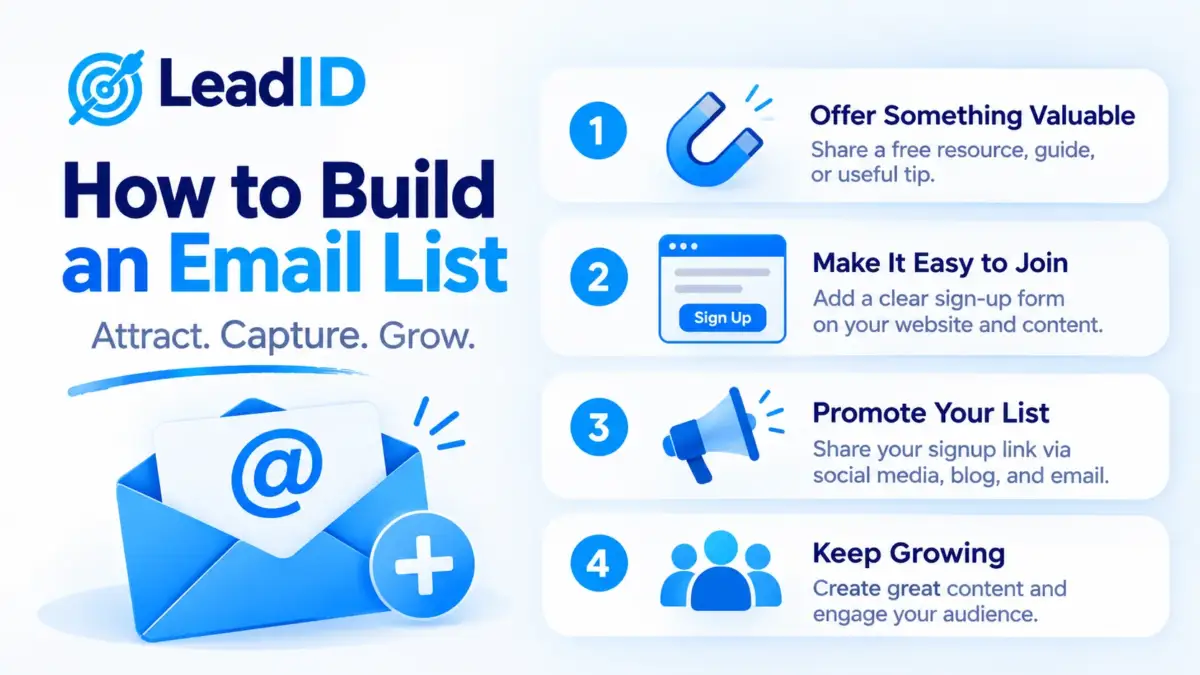
Figuring out how to build an email list in 2026 is harder than any marketing blog admits. Google and Yahoo rewrote the rules in February 2024, lead magnet opt-in rates collapsed, and roughly a quarter of your list decays every year even if you do nothing wrong. Most “how to build an email list” articles still reference 2022-era tactics that no longer carry their old weight.
What follows is an honest 2026 answer: the opt-in channels that still convert, the ones that have gone stale, the compliance floor every sender now has to clear, and the subscriber-decay math nobody wants to put on the first page. Current email marketing statistics put welcome email open rates near 60% and campaign opens in the low 30s, so list quality shows up in the very first touch and keeps building from there.
Key Takeaways
Quick Answer: How To Build An Email List In 60 Seconds
Start here if you have:
No list and SMB traffic under 5K/mo: embedded form on top-3 pages + exit-intent popup with specific finding or template + warm the sending domain in parallel.
Early-stage SaaS, no traffic: pre-launch waitlist landing page + guest podcasting + referral loop; skip popups entirely until you have 2K monthly visitors.
Ecommerce (DTC): gamified wheel popup on homepage + first-purchase discount + abandoned-browse automation. Expected opt-in rate 8-12% on cold traffic.
What Changed In 2024 That Rewrites How To Build An Email List
February 1, 2024 was the turning point. Google and Yahoo together rolled out new rules for bulk senders that apply to anyone pushing more than 5,000 messages per day to Gmail or Yahoo inboxes, which covers almost every ecommerce brand and most B2B SaaS teams running newsletters. The rules are not optional. Senders that fail them land in spam right away, no matter how good the list quality is.
Three requirements matter for list building. First, SPF, DKIM, and DMARC authentication on the sending domain (these are the three email identity checks that prove you are the real sender). Second, a one-click list-unsubscribe header in every marketing message, which is a technical header separate from the unsubscribe link in the email body. Third, a spam complaint rate under 0.3%. Above that, Gmail starts slowing your sends and eventually blocks the domain.
What this means in practice: list quality is now a technical requirement, not a nice-to-have. A list built on bought data, scraped emails, or “we assumed consent from the download” signups will cross the 0.3% complaint rate and ruin your deliverability within two sends. Permission-based signups and clean list hygiene used to be a good practice; in 2026 they are the only way to stay inside the sending window at all.
Authentication, reputation, and complaint rate decide inbox placement, which is the same math that drives cold email deliverability for every other sender. The permission layer is the only part that changes between cold outreach and permission-based marketing; the infrastructure floor is identical.
Honest Email List Decay Math: Why You Grow 25% A Year Just To Stand Still
Email lists decay. Not from one specific thing, but from four at once: hard bounces as people change jobs, unsubscribes, soft spam complaints that silence a subscriber without removing them, and plain disengagement where someone stops opening and the ESP eventually suppresses the address. Validity’s 2024 data puts the total annual decay at 22-30% across industries, with higher churn in B2B SaaS (people change jobs) and lower churn in creator audiences (loyal readers who stick around).
Work the math on a 10,000-subscriber list at the 25% midpoint. You lose 2,500 subscribers per year, roughly 208 per month. To grow to 12,500 by year-end, you need to add 2,500 (replacement) + 2,500 (growth) = 5,000 net new subscribers, or 417 per month. If your opt-in flow currently captures 150 per month, you are shrinking even while adding subscribers every day.
Three things follow from this math. Permission-based list building is an always-on process, not a one-time launch push. Your real target is not total list size; it is monthly net adds minus churn. And the time to think about list hygiene is before you lose two years of growth to inactive subscribers quietly dragging down your sender reputation.
12 Proven Ways To Build An Email List In 2026
Not every tactic fits every business. A channel that gets 8% opt-ins on a DTC homepage gets 0.5% on a B2B SaaS blog post, and the other way around. Pick two or three channels that fit your traffic and your audience, then run them well. Stacking all 12 at once gives you worse results than running two deeply.
1. Lead Magnets And Freebies
A lead magnet is a freebie you give away in exchange for an email: a guide, template, checklist, cheat sheet, tool, or free course. It is the single most common way to build an email list, and the format that works has changed a lot since 2022.
Generic PDFs used to get 10-15% opt-in rates. In 2026, the same generic PDF gets 2-5% at best, because readers already have 400 PDFs in a folder they never opened. The freebies that still work solve a real problem in the reader’s workflow rather than just teach about it.
Four freebie formats consistently beat gated PDFs in 2026 and typically get 8-12% opt-in rates on the same traffic:
- Free tools and calculators (ROI, pricing, sizing). Example: HubSpot’s free Website Grader has brought in millions of signups and still drives a steady share of their list growth. Best for SaaS.
- Templates and swipe files (Notion, Google Sheets, Figma). Example: Marie Poulin’s Notion template library and Pat Flynn’s email swipe files are the model. Easiest for creators to make.
- Benchmark or industry reports with filtered data. Example: SparkToro’s “Zero-Click Search” report added over 10,000 signups in one week on launch. Strongest for B2B audiences.
- Free email courses delivered over 5-7 days. Example: Ramit Sethi’s “Earn Your First $1,000 On The Side” course has been running for over a decade and is still one of his top signup pages. Strongest for creators and educators.
2. Embedded Signup Forms (7.39% Opt-In Rate)
An embedded signup form sits inline in the article body or sidebar, with no popup overlay. It is the highest-converting form on content sites because readers who already engaged with the post have shown interest. Place it twice: once after the first H2 (for people who skim and leave quickly) and once near the end (for readers who finish the piece).
Example: Backlinko (Brian Dean) and The Hustle both drop inline signup boxes right inside their blog post content, roughly a third of the way down. Backlinko’s inline form on their top SEO posts regularly outperforms their homepage signup form by 3-4x.
3. Exit-Intent Popups (3.94% Opt-In Rate)
Exit-intent popups show up when the mouse leaves the browser window on desktop or when someone taps the back button on mobile. The opt-in rate is modest but still a win, because the visitor was already leaving. Offer something tied to the page they are on (a template, calculator, or benchmark), not a generic “subscribe to our newsletter” box.
Example: OptinMonster’s own site uses an exit-intent popup offering a free Email Marketing Guide, which converts around 4-6% of exiting visitors. Shopify’s blog runs a “Wait, before you go…” exit popup with a free ebook on their most-trafficked guides.
4. Timed Popups (5.37% Opt-In Rate)
Timed popups show up after a dwell threshold (10-30 seconds) or scroll depth (50-70%). They beat exit-intent on engaged pages but can hurt bounce rate on landing pages. Use scroll depth over a time threshold; it matches real reading intent better.
Example: Neil Patel’s blog triggers a timed popup at around 60% scroll depth offering a free SEO audit tool access. The format pulls 5-7% opt-in rates on his top blog traffic because the offer is tied to intent (SEO readers want the SEO tool).
5. Landing Pages (4.72% Opt-In Rate)
A dedicated landing page converts paid ad traffic and freebie referrals. The 4.72% benchmark is for cold ad traffic; warm social traffic can hit 15-25% on the same page. Keep the form above the fold, one offer, one button, no site navigation header. Every extra click or link lowers conversion.
Example: Morning Brew’s /subscribe/ landing page is a textbook version: one hero image, one benefit sentence, one email field, one button, zero site navigation. ConvertKit, Beehiiv, and Substack creator pages all follow the same stripped-down pattern.
6. Content Upgrades (5-8% Opt-In Rate)
A content upgrade is a freebie tied to a specific article. If you wrote a 3,000-word post on cold email templates, offer a downloadable template library inside that post. Topic relevance beats a site-wide offer because the reader has already shown interest in that exact topic.
Example: Brian Dean (Backlinko) popularized this format in 2015 by attaching a downloadable PDF checklist to his “Google Ranking Factors” post, which raised that post’s opt-in rate from around 2% to 11%. The same pattern is now standard across Ahrefs, Moz, and SEMrush blog posts.
7. Discounts And Welcome Offers (8-12% Opt-In Rate, DTC)
First-purchase discount codes, free shipping thresholds, and loyalty signups are the main email capture lever for DTC ecommerce. “10% off your first order when you sign up” gets 8-12% opt-ins on cold DTC homepage traffic.
Example: Glossier, Warby Parker, Allbirds, and Casper all run “sign up for 10-15% off your first order” welcome popups on first-time visitors. Death Wish Coffee uses a free-shipping offer on signups above $25.
Gamified popups (spin-to-win wheels, scratch cards) fit here too and get 29.99% opt-ins on cold DTC traffic, the highest of any form type. Keep gamified formats out of B2B; they read as spammy in a professional context.
8. Giveaways And Contests
A product or gift-card giveaway in exchange for a signup can get 2-5x your normal opt-in rate during the campaign. Tools like ViralSweep, KingSumo, or Gleam handle the entry mechanics and bonus-entry referrals.
Example: Harry’s Razors famously built a 100,000-person pre-launch list in one week with a referral-tiered giveaway (3 referrals = free shaving cream, 5 = free razor, 50 = free products for a year). Beardbrand runs a monthly product giveaway and consistently adds 2,000-4,000 subscribers per campaign.
One honest caveat: giveaway lists churn faster than other signups because many entrants only came for the prize. Clean the list 30-60 days after the giveaway ends by removing anyone who did not open a follow-up email. Otherwise your long-term open rates will drop.
9. Social Media CTAs (1-3% Of Followers)
Turn LinkedIn, Twitter, Instagram, TikTok, and YouTube followers into email subscribers. Rented audiences disappear overnight when a platform changes its algorithm; owned subscribers do not. Pin a freebie link to your profile, mention the newsletter in every third post, and run occasional subscriber-only threads to make the email list feel like insider access.
Example: Justin Welsh pins his “LinkedIn Operating System” freebie to his X and LinkedIn profiles and mentions his newsletter in roughly every third post; the pattern converts around 3% of his follower base to active subscribers. Alex Hormozi runs the same play on YouTube with a pinned comment linking to acquisition.com.
10. Pre-Launch Waitlists (15-30% Of Referral Traffic)
Early-stage SaaS products and product launches use pre-launch waitlists to collect signups before they ship. The exclusive feel (closed beta, early-bird pricing, founding member perks) pushes conversion rates well above standard landing pages.
Example: Robinhood built a 1 million person waitlist in one year using a referral-tiered pre-launch page where your position in line moved up as you referred friends. Prisma, Linear, and Superhuman built their first lists the same way before opening to the public.
11. Referral Programs (0.3-0.7 New Signups Per Subscriber)
Give subscribers a reason to refer other people (early access, bonus content, physical merch at referral tiers like 5, 10, and 50 referrals). A 10,000-subscriber newsletter at a 0.5 referral rate adds 5,000 new signups per cycle before any paid ads.
Example: Morning Brew reached 1.5 million subscribers using subscriber-driven referral tiers (5 referrals = stickers, 15 = coffee mug, 50 = T-shirt, 1,000 = brewers paying for a trip to NYC). The Hustle, Milk Road, and SparkToro all run the same play with their own merch tiers. SparkLoop and Beehiiv now bundle this as a built-in feature for newsletters.
12. Webinars And Live Events (20-40% Of Registrants)
Hosting a free webinar or workshop collects email signups at the registration step. Of registrants, 20-40% stay active subscribers after the event (compared to 5-10% for a static PDF freebie). Partner with another creator or brand for cross-audience reach, and record the session so the replay keeps bringing in signups for weeks after.
Example: HubSpot Academy runs weekly product and marketing webinars that consistently add thousands of registrants per session. Drift’s “weekly office hours” format worked the same way for their early list growth. On the solo side, Lenny Rachitsky’s live AMAs with product leaders routinely add 2,000-5,000 new subscribers per session.
B2B SaaS Vs Ecommerce Vs Creator: 3 Different Email List Approaches
List-building advice gets watered down because most articles mix the three main business types into one. The channels that build a 50,000-contact DTC list in six months will not build a 500-subscriber B2B SaaS list in a year, and the other way around. Match the approach to the business.
The B2B SaaS approach is slower on raw numbers but much higher on contact value. A 2,000-contact B2B list with real buying intent earns more per subscriber than a 50,000-contact DTC list. Pick the right number to improve before copying someone else’s channel mix.
Email List Opt-In Conversion Rate Benchmarks By Form Type
Benchmark numbers only matter if you compare like for like. The chart below shows cold-traffic average opt-in rates, sourced from BDOW’s 2026 popup study and Omnisend’s March 2026 ecommerce report. Warm traffic (returning visitors, referral traffic) runs 2-3x higher on the same form; paid cold traffic runs lower.
Three practical notes on the numbers. Mobile opt-in rates run 15-25% lower than desktop for every form type, so mobile-first testing matters. The gamified wheel’s 29.99% is DTC-specific and crashes in B2B contexts. Content upgrades beat site-wide popups for the same visitor because topic relevance beats offer novelty.
Compliance For Building An Email List: 2024 Rules + GDPR + CAN-SPAM
Three rulebooks apply to an email list in 2026: the US CAN-SPAM Act, the EU and UK GDPR, and Google and Yahoo’s February 2024 bulk-sender rules. The three add up (they do not cancel each other out). If you send to US, EU, and Gmail or Yahoo recipients, you have to clear all three.
Double opt-in is required under GDPR for EU and UK subscribers, and it is good practice globally because it filters out typo signups and bots that would otherwise push the complaint rate up. It does cost 10-20% of opt-ins at the confirmation step; that feels like a loss until you look at deliverability data from single-opt-in lists six months later.
One easy fix: a confirmation email that names what the subscriber signed up for recovers 3-5% of the drop-off. Generic “please confirm your subscription” emails lose more people at this step than specific ones like “confirm your spot in the Weekly SaaS Pricing Teardown”.
New-Sender Deliverability: Why Your First Email List Sends Hit Spam
A brand-new sending domain has no reputation with Gmail, Yahoo, or Outlook yet. The inbox providers do not trust it because they have no history of engagement signals from recipients (opens, replies, no complaints). Without a warmup process, a fresh domain’s first 1,000 sends land in spam at 40-70% rates, which then hurts the sender reputation for every send after that. It is a chicken-and-egg problem that only warmup solves.
Mailbox warmup is the slow ramp from a few sends per day to full volume over 2-6 weeks, where tools simulate healthy engagement (opens, replies, inbox placement) across a network of warmup mailboxes. A new sending domain under 1,000 sends per day still needs mailbox-level warmup to earn placement, and the best email warmup tools handle that for most teams in the background while your list grows separately.
One easy setup note: send from a subdomain (news.yourdomain.com, email.yourdomain.com) rather than the root domain. Validity’s 2024 data shows root-domain senders hit 26.0% spam placement vs 13.3% for subdomain senders. That 2x gap exists before you even start warmup, which makes subdomain setup the single highest-return deliverability move you can make at zero subscribers.
When Cold Outreach Beats Building An Email List (And When It Doesn’t)
Learning how to build an email list is a 3-6 month investment at minimum before the compounding kicks in. If you need pipeline this quarter and have no list to send to, the honest answer is that compliance-safe cold outreach to verified B2B contacts can fill the gap. The two approaches are complementary, not opposed.
Cold outreach wins when: your target customer is identifiable at the account level (B2B SaaS, agency services, high-ticket services), your deal size justifies a 3-5% reply rate math (ACV above $5,000), and you have no owned audience yet. Permission-based list building wins when: your target customer is unidentifiable at the account level (consumer, long-tail SMB), your deal size is low enough that volume matters more than targeting, and you have time to compound over 12-24 months.
Most teams need both, run in phases. Cold outreach for the first six months while the list grows in the background, then more weight on the owned list once it crosses 1,000-2,000 subscribers. The timing on the welcome sequence also matters: list growth gets wasted if the first email lands at the wrong hour, which is why pairing opt-in volume with the right best time to send emails does more for your results than swapping tactics every month.
Bottom Line
How to build an email list in 2026 is a long game under new rules. The February 2024 Google and Yahoo bulk-sender rules make authentication, one-click unsubscribe, and the 0.3% complaint rate required, not optional. The 25% annual decay math means list growth has to be ongoing, not launch-driven. The channels that still convert favor interactive assets over gated PDFs and topic relevance over novelty.
Pick two or three channels that fit your traffic, warm the sending subdomain at the same time, swap the generic PDF for a free tool or template, and run double opt-in with a specific confirmation line. Welcome emails get 50%+ open rates in 2026, which is why strong welcome email examples decide how much of your 90-day retention sticks from that very first email. Everything else is fine-tuning once that foundation is set.
FAQs
1- How long does it take to build an email list from scratch?
Expect 3-6 months to hit the first 1,000 subscribers with consistent opt-in capture across two channels. The compounding kicks in after that: a list growing at 25% net monthly reaches 10,000 in 12-18 months from the 1,000 baseline. Pre-launch waitlists speed this up to 4-8 weeks for the first 1,000 if the exclusive-access offer is compelling.
2- Should I buy an email list to get started faster?
No. Bought lists cross the 0.3% complaint rate under Google and Yahoo’s 2024 rules within one send, ruin your sending domain’s reputation, and often break CAN-SPAM and GDPR at the same time. The time saved on list acquisition gets reversed into 6-12 months of deliverability recovery work. Compliance-safe cold outreach to verified B2B contacts (not purchased lists) is a legitimate alternative; buying consumer or marketing lists is not.
3- How many email subscribers do I need to monetize?
It depends on business type and offer. A B2B SaaS with $200 ACV monetizes a 500-subscriber list at $20-40 MRR per subscriber per year; a creator newsletter needs 10,000-25,000 subscribers for the first full-time income tier via sponsorships. DTC ecommerce lists convert at 1-2% per campaign, so 5,000-10,000 subscribers typically generate $3,000-$8,000 per campaign on a $50 AOV product.
4- Is double opt-in worth the drop-off?
Yes in almost every case. The 10-20% confirmation step loss is more than recovered through better deliverability (fewer complaint signals, lower bounce rate, higher ISP reputation) and higher engagement (confirmed subscribers open at 2x the rate of single-opt-in subscribers). Specific confirmation lines (“confirm your spot in the SaaS pricing teardown weekly”) recover 3-5% of the drop-off vs generic ones.
5- What is the best lead magnet for building an email list in 2026?
Interactive assets. Free tools, calculators, Notion templates, Google Sheet workbooks, and benchmark reports pull 8-12% opt-in rates where generic PDFs on the same topic pull 2-4%. The reason is practical utility: a template the reader will use next Tuesday has retention value; a PDF they already know they will not read has none.
6- Do pop-ups still work for email list building in 2026?
Yes, with constraints. Exit-intent still averages 3.94%, timed popups 5.37%, and gamified wheels 29.99% on DTC. However, pop-up fatigue data from 2024-2025 shows that stacking three or more popups on one page causes bounce rate increases that cancel the opt-in gain. One popup per page is the current ceiling for net-positive outcomes.
7- Should I send from a subdomain or my root domain?
Subdomain. Validity’s 2024 benchmark data shows root-domain senders hit 26.0% spam placement vs 13.3% for subdomain senders. That 2x gap exists before any other variable, which makes subdomain isolation (news.yourdomain.com, email.yourdomain.com) the single highest-ROI deliverability decision you can make at zero subscribers.
8- What is the average cost per email subscriber in 2026?
Paid acquisition costs run $1-$5 per subscriber on Meta ads, $3-$12 on LinkedIn, and $0.50-$2 on referral loops once established. Organic SEO content converts opt-ins at an effectively $0 marginal cost after content investment. Building one interactive asset (a free tool or calculator) typically costs $1,500-$8,000 one-time and works out to under $0.20 per subscriber after the first 1,000 signups.
9- How do Google and Yahoo’s 2024 rules change list-building?
Three mandates reshape it. SPF, DKIM, and DMARC authentication on the sending domain. One-click list-unsubscribe header (RFC 8058) in every marketing message. A 0.3% spam complaint ceiling, above which placement starts degrading and the domain eventually gets blocked. These apply to any sender pushing 5,000+ messages per day to Gmail or Yahoo inboxes, which covers almost every real list.
10- Can I grow an email list without a website?
Yes, with limits. Pre-launch waitlist pages (Prisma, Linear, Superhuman used this pattern), social-to-email funnels on Twitter, LinkedIn, Instagram, and TikTok, podcast guesting with a mentioned signup link, and newsletter cross-plugs with similar-audience creators all work without a traditional site. Expected monthly adds run lower (100-500 vs 400-2,000 with content SEO) but the capital cost is near-zero.


Pingback: 60+ Email Marketing Statistics That Decide Your 2027 ROI - LeadID
Pingback: Email Marketing KPIs in 2026: 15 Metrics, Formulas, and Benchmarks
Pingback: Best Email Marketing Campaigns 2026: 12 Real Brand Examples