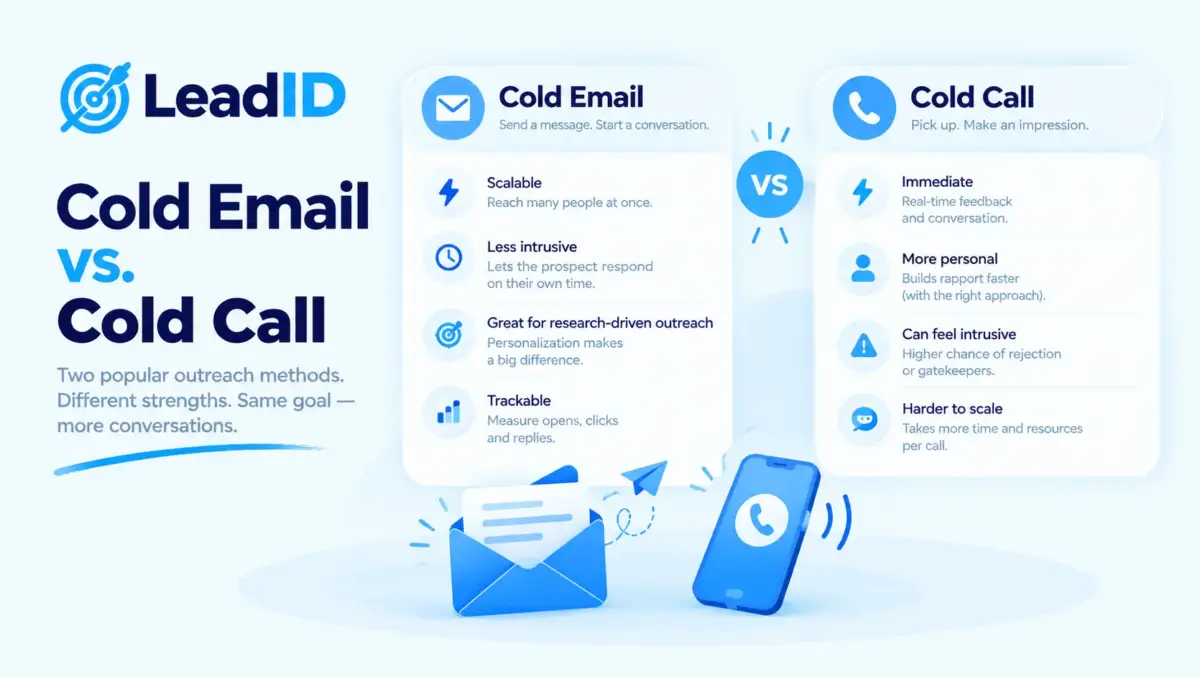
You have a list of 500 prospects. Should you email them or call them? The cold email vs cold call question feels simple on the surface. In practice, it is the one that quietly decides whether an outbound program hits quota or stalls at 20% of target.
Most sales teams pick a side and defend it. Email people say calling is dead. Call people say email is spam. Both are wrong. Email and phone are the two main channels inside any outbound sales program, and the right mix depends on buyer, ACV, and team size. In our own work running outbound across SMB, mid-market, and enterprise accounts, the channel that wins is picked by who the buyer actually is, not by what feels productive to the rep. A VP of Engineering at a 2,000-person SaaS reads email at 10pm and never picks up an unknown number. An HVAC business owner answers every call during the workday and reads email once a week on Sunday morning.
Below is the full head-to-head: real reply rates, cost per meeting, when each channel actually wins, and the hybrid play that beats either one alone by 2.5x. The right cold email software stack handles the sending side of this equation, and the comparison below assumes you already have that foundation in place.
Key Takeaways
Quick Answer: Cold Email Vs Cold Call In 2026
Cold call wins when: your ACV is over $25K, your buyer is an SMB owner or mid-level manager who still answers the phone, or you have strong intent data pointing at a 48-hour buying window.
Hybrid wins when: both apply, and you have the headcount to run calls after email replies.
If you are forced to pick one and only one, pick email. It scales better and burns less headcount per lead. If you can run both, run both. The math works out below.
Agency sellers in particular need to pair a tight sender setup with cold email templates for agencies that lead with a specific finding on the prospect’s property, since generic service pitches have been burning reply rates across the agency space since 2024.
Cold Email Vs Cold Call: Side-By-Side 2026 Numbers
Here is the honest head-to-head. Every number is sourced from a 2025 or 2026 benchmark study. Your actual results will vary with list quality and vertical.
| METRIC | COLD EMAIL | COLD CALL |
|---|---|---|
| Average response/connect | 3.43% reply (Instantly) | 5.4% to 9.9% connect per dial (Gong, Belkins) |
| Meeting booking rate | 1-2% of sends | 2.3% of dials (Cognism) |
| Top-quartile performer | 10%+ reply rate | 16.7% set rate after connect |
| Dials/sends per meeting | ~75 sends | ~402 dials (average rep) |
| Daily output per rep | 500-1,000 sends possible | 4.4 quality conversations |
| Cost per touch | $0.03-$0.20 | $3-$8 |
| Cost per booked meeting | $15-$80 | $80-$350 |
| Time to first touch | Seconds (scheduled) | 2-3 minutes live |
| Scale ceiling | Thousands/day (multiple inboxes) | 50-80 dials/day sustainable |
Read the table one way and the story is clear: cold email wins hard on volume and cost per contact. Cold call wins on conversion quality once the person actually picks up. The hard part is getting them to pick up in the first place.
Real Cost Per Booked Meeting (Cold Email Vs Cold Call)
Reply rate alone is misleading. The number that matters is cost per booked meeting, because that is what feeds pipeline. Here is what each channel actually costs.
Cold Email: $15 To $80 Per Meeting
For a mid-market program sending 500 cold emails per week per rep:
- Tools (data + sender + verifier): $200-$400/mo per rep
- Rep time (full-time, loaded cost): $5,000-$7,000/mo
- Mailboxes and domains for rotation: $50-$150/mo
- Total monthly cost: $5,250-$7,550 per rep
At 2,000 sends per month per rep with a 1.5% meeting rate, that is 30 meetings. Cost per meeting works out to roughly $175 to $250 at loaded cost, or $15 to $80 if you only count tool spend (not the rep’s salary).
Cold Call: $80 To $350 Per Meeting
For a mid-market cold-calling program running one SDR full-time:
- Rep salary (US SDR average): $43,709 base plus $20K OTE = ~$5,300/mo loaded
- Dialer software (JustCall, Orum, Nooks): $100-$200/mo
- Mobile data provider (Lusha, Cognism): $200-$500/mo
- Total monthly cost: $5,600-$6,000 per rep
An average rep makes 80-150 dials per day, which lands 4.4 quality conversations per day (Bridge Group) and roughly 15-25 meetings per month. Cost per meeting runs $240-$400 loaded, or $80-$350 if you strip out salary.
When Cold Email Wins This Fight
Cold email is the right primary channel in five specific situations. If you fit any of these, email first.
1. You Are Targeting Enterprise VPs And C-Suite
VP-level and above screen calls almost universally in 2026. They have an executive assistant forwarding unknown numbers to voicemail, a direct dial that nobody picks up during the workday, and a Caller ID service flagging anything that looks like outbound sales. Cold calls to Fortune 1000 CMOs land at under 1% connect in our own tests across financial services and SaaS verticals.
Email reaches the same person because they read it on their phone at 9pm. LinkedIn’s 2025 State of Sales report found 63% of VP-plus buyers check email outside business hours daily, and 41% read it within 10 minutes of waking up. That is the window where a strong subject line fights for attention, not the window where your SDR dials a direct line.
The right play for enterprise is a precise ideal customer profile definition before you write a single email. Narrow the title, firmographic size, tech stack, and funding stage before anything else. A loose ICP is why most enterprise cold-email programs come in at 1% reply instead of the 5% they could hit with the same tooling.
2. Your Team Has Fewer Than Two Dedicated SDRs
Cold calling needs a human on the phone for four to six hours a day to produce predictable pipeline. If your team is a founder and a part-timer, you cannot sustain that volume without burning the founder’s calendar on prospecting instead of selling or building the product. We see this fail every quarter at seed and Series A companies. A founder commits to calling, lasts 10 days, then quietly stops.
Email scales without additional headcount because sending is asynchronous. A single operator with Instantly or Smartlead can run 500 touches a day across five rotating inboxes and still have 30 minutes for personalization. The same operator could not make 500 calls in a day no matter what dialer you give them.
The breakeven for adding a dedicated cold caller sits around two SDRs on the team and $50K ACV. Below that threshold, email runs the entire outbound function and the founder stays focused on closing warm pipeline.
3. Your ACV Is Under $25,000
Run the math on a real example. A $10K deal with cold-call acquisition cost of $300 per meeting needs a meeting-to-close rate above 10% to break even on prospecting alone. Hitting that number consistently is hard. The same deal with cold-email acquisition cost of $50 breaks even at 2%, which most ICPs can reach without heroics.
The gap widens as deal size shrinks. A $3K product sold through cold outreach needs meeting cost under $30 to work economically, and only cold email can hit that number at scale. Running cold calls on a $3K-ACV motion loses money unless the call also closes the deal in the same conversation, which rarely happens outside SMB freemium-to-paid flows.
Above $25K the economics start to level. Above $50K cold calling is usually cheaper per closed deal, because a 15-minute live conversation surfaces budget and timing far faster than three weeks of email back-and-forth.
4. You Need To Prospect Across Multiple Time Zones
Email runs asynchronously, which is how a rep based in New York can prospect a London VP at 8am ET (1pm London), a Tokyo buyer at 7pm ET (9am Tokyo), and a Sydney buyer at 5am ET (9pm Sydney) all from one desk, same day, same inbox. Scheduling tools like Instantly handle the delivery windows automatically so each message lands during local working hours.
Cold calling across time zones multiplies headcount instantly. To cover EMEA from Pacific time, you either staff a European SDR who shares zero overlap hours with your HQ team, or you force your US rep to call at 4am. Both choices have real costs. In practice, teams that try to cold-call global prospects from one time zone cover one region well and the others poorly, which is why global ABM programs almost always lead with email.
If your total addressable market crosses more than two time zones, email is the only honest first channel.
5. You Need A Documented Paper Trail
Legal, procurement, and compliance teams in regulated industries (financial services, healthcare, defense, pharma) require every outreach touch in writing with a timestamp and content record. Cold email creates this automatically. Instantly and Smartlead log every send, open, and reply with a server-side timestamp that passes a compliance audit without extra work from the rep.
Cold calls either lose the context when the rep forgets to log the call, or require manual CRM notes that nobody writes properly. One internal Salesforce audit we reviewed in 2026 found 38% of logged cold calls had notes under 20 characters (“left vm” or “no answer”) that provided zero compliance value when the account came back around a year later.
If your industry is one where sales activity records can be subpoenaed, and more are starting to, the paper trail from email is non-negotiable.
When Cold Call Wins This Fight
Email loses in five situations. If any of these fit your motion, calling is the better primary channel.
1. You Are Selling To SMB Owners
Small business owners live on their phones. Picture a roofing contractor driving between jobs, a dental practice owner between appointments, or a 15-location franchise operator checking in on managers. For all of them, the phone is how the workday runs. Email gets read Sunday morning or not at all, and only if the subject line survives a weekly bulk-delete.
Connect rates reflect this reality. In our own outbound to SMB prospects under 50 employees, cold calls connect at 12 to 18% per dial on first attempt, which is roughly three times the enterprise rate. Reply rates on cold emails to the same ICP sit at 1 to 2%, half what we see for mid-market knowledge workers who read email all day.
The mobile number is the gate. SMB owners rarely sit at a corporate switchboard, so a verified mobile line from a solid b2b data provider connects you straight through. You bypass the gatekeeper, the voicemail tree, and the shared-line IVR all at once.
2. Your ACV Is Over $50,000
For a $100K deal, booking one meeting through 50 cold calls at $8 each costs $400 total. That is 0.4% of ACV, a rounding error inside the sales commission structure. The same $400 spent on cold email across 1,000 sends might book 10 meetings, but only one or two of those will be qualified at the enterprise end once you filter for budget and buying authority.
The phone also compresses the sales cycle. One 15-minute discovery call surfaces budget, authority, timeline, and genuine fit (classic BANT in a single conversation). The same information takes three weeks of email ping-pong on average, during which deals go cold, get picked up by a competitor, or the champion changes jobs.
For deals above $50K, the cost per qualified meeting is what matters, not the cost per touch. Cold call wins that number every time.
3. You Have A 48-Hour Buying Window Signal
Trigger events open short windows. Any of these creates a 48-hour period where a prospect is more receptive to a conversation than they will be for the rest of the quarter: a funding announcement, a job change at the target account, a product launch, a competitor layoff, or a new office opening.
Growth List’s 2025 benchmark showed the first vendor to reach a prospect inside a 48-hour trigger window wins five times more deals than vendors who reach them a week later. Email loses this window. Your sequence might not land for 72 hours by the time warmup rotation and send-time optimization resolve, and by then the champion has already taken a call from a faster competitor.
Pulling signal data from intent data sources straight into your dialer lets your SDR call within 60 minutes of a trigger firing, which is where cold calling earns its cost premium over email.
4. Your Inbox Deliverability Is Already Burned
If your sending domain has reputation damage, your emails are landing in spam folders. The signs are specific: a spam filter blacklist entry, a sudden drop in open rates below 30%, hard bounces climbing past 5%, or a Google Postmaster complaint rate above 0.3%. No amount of subject-line optimization will fix placement in the current week.
Rebuilding reputation takes 14 to 21 days of careful warmup, sometimes longer if the damage is severe. Cold calling is the bridge during that window. The channel does not depend on inbox placement at all, so you can keep pipeline flowing while you repair sender reputation on a parallel track. We have seen teams book 60% of a quarter’s meetings through cold calls alone while their email infrastructure was in repair.
Monitoring cold email deliverability weekly (open rates, bounce rates, spam complaint rates, placement tests) prevents the burn in the first place. Once the damage is done, calls are the only active channel left.
5. You Need Immediate Qualification
Three minutes on the phone qualifies a prospect better than three weeks of email back-and-forth. On a live call, you ask about budget, you ask about timeline, and you ask who else needs to approve the deal. You also hear the pauses and the tone that reveal whether this account is a real buyer or a polite responder running out the clock.
For complex B2B deals with seven or more stakeholders, custom pricing, or multi-month implementation cycles, this qualification speed is non-negotiable. Email cannot surface the honest answers that a phone conversation does, no matter how well the sequence is written. A prospect will reply “we’re interested in learning more” by email when the live truth is “we signed with your competitor three weeks ago but I’ll take the meeting out of politeness”.
The pattern we see in our own enterprise work: cold calls that convert to meetings close roughly two times faster than meetings sourced through cold email alone, because the call already did half the qualification before the first calendar invite went out.
Why Hybrid Beats Either Alone
The best cold outreach programs do not pick one. They run both, in a specific order, and the compound effect is huge.
SalesHandy’s 2026 data shows that pairing email with a call lifts positive reply rate by 2.5x versus email alone. Gong’s data shows a cold call before an email bumps email reply rate from 1.81% to 3.44%, nearly doubling it.
The sequence below runs 21 days with seven touches total: three emails, two calls, one LinkedIn note, and one breakup email. The spacing matters as much as the channel mix. Each touch references the previous one so the prospect does not feel like they are being hit by random outreach from a database. Writing a clean cold email follow-up inside this sequence is what separates hybrid programs that book meetings from hybrid programs that only add noise.
7-Touch Hybrid Sequence (Email + Call Mix)
- Day 1: Cold email with specific signal reference.
- Day 3: Cold call attempt 1. If no answer, leave a short voicemail referencing the email.
- Day 5: Follow-up email referencing the voicemail.
- Day 8: LinkedIn connection request plus a short note.
- Day 12: Cold call attempt 2. Different time of day than attempt 1.
- Day 16: Short email with a specific resource (case study, calculator).
- Day 21: Breakup email with permission-to-close language.
Cognism’s data shows 93% of connects happen by the third call attempt and 98% by the fifth. Two calls plus four emails covers that window perfectly.
What You Need To Run Each Channel (Cold Email Vs Cold Call Stack)
Here is the honest stack and cost picture for running cold email, cold calling, or both.
| COMPONENT | COLD EMAIL STACK | COLD CALL STACK |
|---|---|---|
| Contact data | Apollo, UpLead, Hunter ($34-$99/mo) | Lusha, Cognism (mobile data) ($200+/mo) |
| Verification | NeverBounce, ZeroBounce ($10-$30/mo) | Phone verification built into data vendor |
| Sending/dialing tool | Instantly, Smartlead ($40-$300/mo) | JustCall, Orum, Nooks ($100-$300/mo) |
| Mailboxes/domains | 3-10 for rotation ($50-$150/mo) | Parallel dialer local presence ($50/mo) |
| Headcount | 0.5-1 FTE per 1,000 sends/week | 1 FTE per 80-150 dials/day |
| Setup time | 2-4 weeks (warmup required) | 1-2 days (dialer configuration) |
| Monthly cost per rep | $200-$400 (tools only) | $300-$600 (tools only) |
Cold Email vs Cold Call: Common Mistakes Running Either Channel
- Picking a side religiously. Email evangelists ignore the fact that SMB owners answer phones. Call evangelists ignore the fact that enterprise VPs don’t. Both lose pipeline.
- Measuring the wrong number. Reply rate is not meeting rate. Dials made is not conversations had. Measure cost per booked meeting and nothing else.
- Scaling calls past 150/day per rep. At 150 dials, quality drops below 4 conversations per day. Add another rep instead.
- Running cold email without warmup. Jumping to 100 cold emails per day on a fresh mailbox lands you in spam before week two. A proper email warmup ramp takes two to four weeks of gradual volume increase, and skipping it always backfires inside the first month.
- Ignoring the real sending ceiling. The published Gmail cap is 2,000 messages per day, but how many emails you can send before spam is the actual limit. The honest ceiling is usually 50 to 80 per inbox per day for cold sends before reputation starts to slide.
- Buying mobile data from the wrong vendor. Cold calling without verified mobile numbers wastes 70% of dial time on bad numbers. Lusha and Cognism verify at the Diamond tier for a reason.
- Ignoring the hybrid lift. Running email and calls as separate silos leaves the 2.5x compound effect on the table. Reference each channel inside the other.
Bottom Line
The cold email vs cold call question has a simple default: if you can only pick one, pick cold email. It costs 3 to 5 times less per booked meeting and scales without additional headcount.
If your ICP is SMB owners or your deal size is over $50K, add cold calling to the mix. If you can afford both, run the 7-touch hybrid sequence and watch positive reply rate climb 2.5x versus either channel alone.
The only wrong answer is picking a side religiously and defending it. Both channels work. Both have real benchmarks. Match the channel to the buyer, not to your preference.
Signal-based cold email personalization lifts the email side of the equation most, which is where most teams see the fastest reply-rate gains after a channel-choice correction.
FAQs
1- Cold email vs cold call: which is more effective in 2026?
Depends on who you are targeting. Cold email wins on cost per meeting (3-5x cheaper) and scale (1,000+ sends per day possible). Cold calling wins on conversion once someone picks up (4.6% average set rate, 16.7% top-quartile). For most B2B programs, email is the better primary channel, with calls layered on top.
2- What is the average reply rate for cold email?
3.43% is the 2026 industry average per Instantly’s benchmark of 53M emails. Top-quartile campaigns reach 5.5%, and the top 10% of senders exceed 10%. Woodpecker’s median is lower at 1.5% across 56,000+ campaigns, so vary your expectations by vendor source.
3- What is the average connect rate for cold calling?
5.4% per dial on average (Gong, 300M+ calls analyzed). Top-quartile reps reach 13.3%. Per prospect across multiple attempts, the connect rate climbs to 24.5% (Belkins), meaning roughly 1 in 4 prospects eventually picks up if you call 3-5 times.
4- Is cold calling dead in 2026?
No. 82% of buyers report accepting a meeting from a cold caller (RAIN Group, 488 buyers surveyed). The channel struggles with VP-level enterprise buyers who screen calls, but works at SMB and mid-market where decision-makers still answer their phones.
5- How many cold calls can one SDR make per day?
80-150 dials sustained. Beyond that, quality drops. The Bridge Group benchmark shows average SDRs land 4.4 quality conversations per day regardless of dial volume. Add another rep to scale, not more dials per rep.
6- Is cold email cheaper than cold calling?
Yes, by 3 to 5 times on cost per booked meeting. Cold email runs $15-$80 per meeting in tool spend. Cold call runs $80-$350 per meeting in tool spend. Add rep salary and the gap narrows but email still wins.
7- Should I run cold email and cold calling together?
If you can afford both, yes. SalesHandy’s 2026 data shows pairing email with a call lifts positive reply rate 2.5x versus email alone. Gong shows a cold call before email bumps email reply rate from 1.81% to 3.44%. Reference each channel inside the other for the full compound effect.
8- What is the best channel for enterprise sales?
Email first, call second. VP-level enterprise buyers screen calls almost universally and read email on their phones at off-hours. Lead with a well-personalized email, follow with a call only after they engage.
9- What is the best channel for SMB sales?
Call first, email second. Small business owners pick up their phones directly and often ignore email during the workday. Reverse the enterprise approach: lead with the call, follow with a confirmation email referencing the conversation.
10- What is a good meeting booking rate for cold outreach?
For cold email: 1-2% of sends. For cold calling: 2.3% of dials industry average, 11.3% for top performers like Cognism’s own team. For hybrid programs: 3-5% of total contacts touched, which is why running both wins when you can afford it.



Pingback: Best Cold Email Software 2026: 12 Picks Grouped by Stack Role
Pingback: Cold Email Personalization: 7 Signal Tiers for 2026
Pingback: Cold Email Outreach in 2026: Process, Tips, and Mistakes to Avoid
Pingback: Cold Email Deliverability 2026: Why It Drops and How to Fix It