Cold-email reply rates from C-suite decision makers hit 1-2% in 2027, down from 4-5% in 2021. The emails did not get worse; the gatekeeping did. Executive assistants, unified-inbox tools like Superhuman and Shortwave, and the sheer volume of outbound noise together filter 60-75% of carefully-researched outreach before a decision maker reads a single word. Every tools-to-find-business-decision-makers list in the SERP is also written by a vendor that ranks itself first, which does not help if you are actually trying to pick a stack that works.
What follows is an honest 2027 ranking of 12 tools built around a specific sequence: identify the decision maker, verify the contact data, reach the surface they actually check (which is not always the work inbox), and map the 11-person buyer committee Gartner found around every enterprise deal. Picking the wrong data layer caps the ceiling on every downstream lead generation tools decision, because sender platforms, qualification routing, and CRM sync all get built on top of whichever decision-maker list the team starts with.
Key Takeaways
Quick Answer: Best Tools To Find Business Decision Makers In 60 Seconds
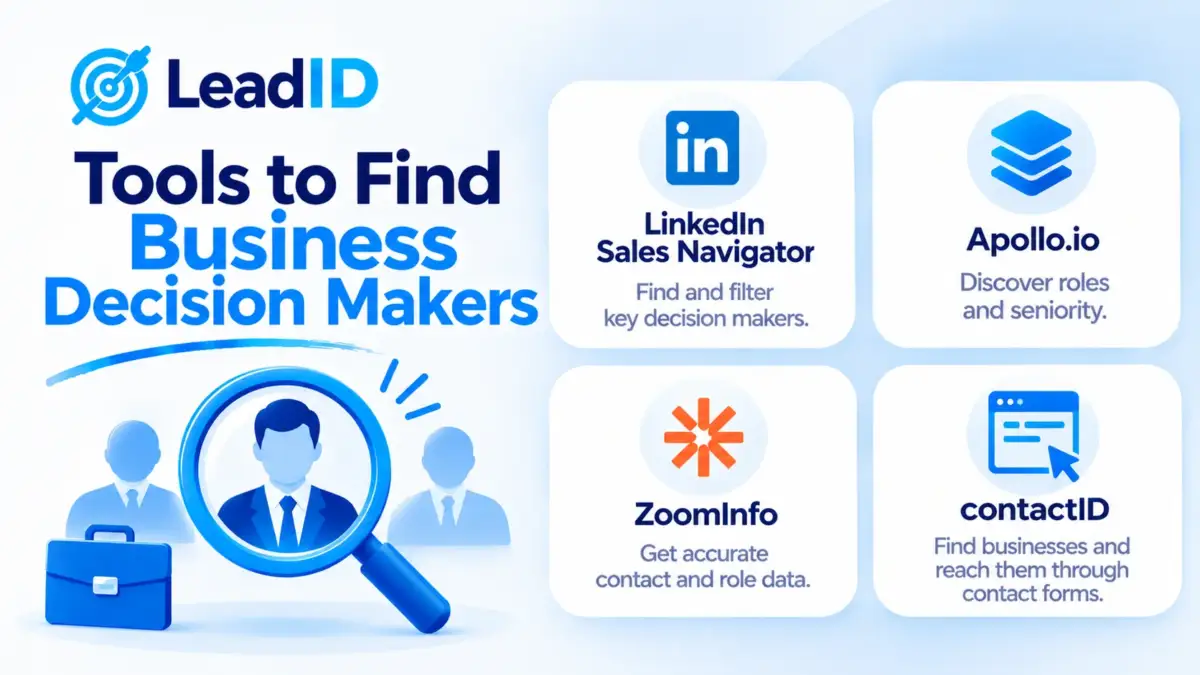
Best for reaching decision makers directly (contact form channel): ContactID (first 10 sites free, $0.15/site after).
Best for identifying decision makers on LinkedIn: LinkedIn Sales Navigator ($99.99-169.99/mo) for the native platform; Clay ($149/mo Starter) for waterfall enrichment across sources.
Best data providers for B2B decision makers: Apollo.io ($49-119/mo/user) for mid-market, ZoomInfo ($15K+/year) for enterprise depth, Cognism (quote-only) for EU/GDPR-safe coverage.
Best phone + mobile for SDR teams: Lusha ($49-99/mo) for direct-dial coverage, Kaspr (~€45/mo Starter) as the EU-safe alternative.
Best intent signal to layer on top: 6sense (enterprise, $60K+/year) for buying-stage prediction; Bombora ($30K+/year) as the cheaper topic-cluster layer.
What To Look For In Tools To Find Business Decision Makers
Most comparison articles rank decision-maker tools by brand awareness. That is backwards. The right pick depends on your ACV, your ICP geography, your compliance posture, and whether your team can actually dial the numbers or submit the forms the tool returns. Here are the six variables that matter most.
- Identification accuracy by seniority. C-suite data ages fastest (people change roles every 18-30 months at that level). Any tool that claims 95%+ accuracy on C-suite contacts without a dated refresh policy is marketing. Run a 25-lead blind self-test on your actual ICP.
- Verified-phone vs scraped-mobile. Vendor-published phone accuracy runs 90%+. Independent dialer tests (Nooks, Orum) consistently measure 40-60% real connect rates on the same numbers. If your SDR team dials, this gap matters more than any other variable.
- Delivery channel coverage. Email-only tools miss the 60-75% of decision makers whose work inbox is gatekept or filtered. Multi-channel stacks (email + LinkedIn + phone + contact form) hit 2-3x higher response rates on hard-to-reach titles.
- Buyer-committee mapping. Enterprise deals now involve 11 stakeholders on average (Gartner 2024). Mid-market deals involve 6-10. Tooling that surfaces only the single “decision maker” misses 70-90% of the influence surface and extends sales cycles by 30-60 days.
- Compliance posture. EU-heavy ICPs need GDPR-safe data sourcing (Cognism, Dropcontact). Scraped LinkedIn data from Chrome extensions (ContactOut, aggressive Lusha configs) carries real legal exposure under EU DPA rulings from 2024-2025.
- Price-to-ACV fit. A $60K/year 6sense contract is wasted below $100K ACV because the intent signal does not pay back fast enough. Apollo at $49-119/mo per user is right-sized for mid-market. Match tool spend to deal value, not vendor marketing.
Why Finding Business Decision Makers Is Harder In 2027
Three shifts between 2021 and 2027 raised the cost of reaching a decision maker at every seniority level and in every industry. Any 2027 tooling decision ignores them at its own expense.
- Gatekept work inboxes. Executive assistants filter C-suite work email more aggressively than in any prior decade. Unified-inbox tools (Superhuman, Shortwave, Hey) add a second filter layer that hides cold outreach from ever showing in the primary view. Cold email reply rates from C-suite dropped from 4-5% in 2021 to 1-2% in 2027.
- LinkedIn 2024-2025 crackdowns. LinkedIn tightened detection on third-party automation (Dux-Soup, Expandi, LinkedIn Helper) through late 2024 and all of 2025. Account restriction risk is real; corporate legal teams increasingly ban LinkedIn-scraping extensions on company devices, pushing teams back to Sales Nav’s native workflow (safer but slower) or compliance-safe extensions (Kaspr, Lusha).
- Buyer-committee inflation. Gartner’s 2024 research puts enterprise buying committees at 11 stakeholders on average, up from 7 in 2018. Mid-market deals now involve 6-10 stakeholders. “The decision maker” is a convenient fiction; the real target is a multi-contact mapping across economic buyer, technical buyer, user, influencer, and champion roles.
The response to these shifts is not another email-finder tool. It is a multi-channel stack that reaches decision makers through the surface they actually check (contact form, LinkedIn DM, mobile phone, assistant), identifies the full 11-person committee rather than one title, and layers intent data only where the ACV justifies the spend.
12 Tools To Find Business Decision Makers At A Glance
This top tools to find business decision makers comparison stacks each pick against free-tier reality, paid entry pricing, workflow role, and the use case where it earns the subscription. Scan the row that matches your role first; the detailed sections start right after.
12 Tools To Find Business Decision Makers In Detail
1. ContactID (Contact-Form Outreach, Parallel Channel)
SMB founders, agency owners, and operations leads filter work email aggressively in 2027 but still check their contact-form notifications in real time. ContactID is the only tool on this list that reaches that surface: a Chrome extension that automates outreach through company contact forms, delivering your pitch to a decision-maker channel the other 11 picks here cannot touch.
Here is how it works in practice. You load a list of target company URLs (Sales Navigator export, Apollo account search, your own research sheet, or ContactID’s built-in B2B lead lists organized by industry and niche), hit run, and the extension visits each site, finds the “Contact Us” form, fills your templated pitch with personalization fields, solves whatever CAPTCHA the site uses, submits, and logs each attempt as Sent, Failed, or No form found. SDRs targeting gatekept executive titles, agency founders doing their own prospecting, and operations leads building B2B lead lists all use the same workflow: identify the decision maker in Sales Navigator (or pick a prebuilt ContactID list), pull the company URL, then let ContactID deliver the first touch through the contact form while email, LinkedIn, and phone follow-ups run in parallel.

ContactID Pricing: free tier covers the first 10 confirmed sends. Pay-as-you-go runs $0.15 per site after. No subscription, no monthly minimum. Credits burn only on confirmed submissions; failed attempts and no-form-found results cost nothing, so you only pay for delivery that actually happened.
Why Pick It: contact-form outreach bypasses every email filter, inbox gatekeeper, and LinkedIn algorithm that cold prospecting in 2027 has to fight. The extension finds the “Contact Us” form on every site in your list, auto-fills your pitch, solves reCAPTCHA / hCaptcha / Cloudflare Turnstile, submits the form, and logs each attempt as Sent, Failed, or No form found. For target lists of SMB founders, agency owners, consultants, and operations leads, reply rates typically land 2-4x higher than cold email on the same list because the message lands in a different, uncrowded surface. ContactID also bundles curated B2B lead lists by industry and niche directly inside the extension, so teams that do not already run a data provider can start outbound on day one without buying Apollo or ZoomInfo first.
The Catch: contact-form outreach works best on companies 10-500 employees where the form still routes to someone with authority. Larger enterprise targets often route forms to a help-desk queue where they will never reach a decision maker, so ContactID pairs with (not replaces) a traditional email stack for enterprise ICPs.
2. LinkedIn Sales Navigator (Native Platform Identification)
LinkedIn is still the surface where decision makers maintain presence in 2027, which makes Sales Navigator the identification layer every serious B2B prospecting stack starts with. Advanced search filters, lead lists, Account IQ for account briefs, and the integrated Smart Links all exist to answer one question: who should you be reaching out to at this account?

LinkedIn Sales Navigator Pricing: Core at $99.99/mo ($79.99 annual), Advanced at $169.99/mo (team features and CRM sync), Advanced Plus at quote (SSO, admin controls). 1-month free trial on Core. Enterprise pricing per-seat.
Why Pick It: no third-party database has LinkedIn’s recency on title changes, company switches, or new-in-role signals. Sales Navigator surfaces these directly within hours of a profile update. The “new decision makers” alert on tracked accounts is the single highest-ROI identification signal in the category, and the 30-day job-change trigger catches 70% of budget authority during the first 100 days.
The Catch: Sales Navigator identifies; it does not deliver. You still need email, phone, or contact-form tooling to actually reach the person. LinkedIn InMail allowance is capped (50/month on Core, 150/month on Advanced), and third-party scraping tools built on top of Sales Nav (Dux-Soup, Expandi, Evaboot) carry account-restriction risk after 2024-2025 LinkedIn crackdowns.
3. Apollo.io (Mid-Market SDR Default)
For mid-market SDR teams building their 2027 stack on a budget, Apollo is the default tool to find business decision makers at a tenth of a ZoomInfo contract. It replaces three tools (data provider, email sequencer, dialer) in one subscription, with 275M+ contacts, a Chrome extension on LinkedIn, a native sequencer, and CRM sync into Salesforce and HubSpot, all bundled at $49-119/mo per user.

Apollo Pricing: free tier gives 900 credits per year. Basic at $49/mo/user, Professional at $79/mo/user, Organization at $119/mo/user. Credits now cover both search and export; the Credit model changes through 2024-2025 now charge against exports and sequence sends, so the “unlimited credits” marketing has real caveats that only surface after you hit a wall. and sequence sends, so the “unlimited credits” marketing has real caveats.
Why Pick It: the integrated workflow (data + sequencer + dialer + CRM sync) saves most mid-market teams $20K+ per year compared to the ZoomInfo + Outreach + Clearbit stack it replaces. Decision-maker filters are strong (title + seniority + department + management level), and the buying-committee view surfaces 6-10 stakeholders per account rather than one.
The Catch: email accuracy is middle-of-the-pack (75-82% in independent blind tests), not best-in-class. The 2024-2025 credit changes mean heavy-export teams need to track usage carefully. Apollo’s own full-feature review covers the Chrome extension, sequencer, dialer, and credit model per-feature with scoring in the full Apollo review with screenshots and pricing math.
4. ZoomInfo (Enterprise Data Depth)
Enterprise sellers chasing deals above $250K ACV pay $15K+/year for ZoomInfo because no competitor matches the org-chart depth, verified direct dials, and firmographic breadth at the top of the enterprise decision-maker market. 125M+ contacts, hierarchical reporting structures, and integrated intent through ZoomInfo Copilot make it the enterprise benchmark against which every other tool to find business decision makers is measured.

ZoomInfo Pricing: quote-only. Enterprise starts around $15K/year and climbs fast. Copilot (intent + account signals) is a separate SKU. Advanced add-ons include TalentOS and OperationsOS. Annual contracts; monthly pricing is not available.
Why Pick It: org-chart depth is where ZoomInfo wins outright. For enterprise selling where the buyer committee spans 11+ stakeholders across economic, technical, user, and influencer roles, ZoomInfo’s hierarchical org data surfaces the full chain faster than any competitor. Direct-dial coverage on senior titles is the highest in the category (though independent connect-rate testing shows the 40-60% dialer reality applies here too).
The Catch: enterprise pricing excludes everyone below $250K ACV from positive ROI. GDPR posture is weaker than Cognism’s on EU contacts. The sales process itself is friction-heavy (demos, quotes, multi-stakeholder approvals), which is ironic for a tool that sells you how to shorten enterprise sales cycles.
5. Cognism (GDPR-Safe EU Data)
Teams selling into EU, UK, DACH, or Nordic markets face a specific problem: ZoomInfo and Apollo have weaker coverage and shakier GDPR footing on EU decision-maker data. Cognism purpose-built around this gap with phone-verified mobile numbers across 95% of EU countries, GDPR-compliant sourcing, and active do-not-contact list screening against EU regulatory registries.

Cognism Pricing: quote-only. Platinum tier starts around $1,500-2,500 per user per year. Unlimited export on most tiers (unusual in the category). The Diamond phone tier dials and verifies each mobile number before shipping it to subscribers, pushing real connect rates above the 40-60% category baseline. is a separate add-on.
Why Pick It: for EU-heavy ICPs, Cognism is the cleanest legal choice. The Diamond Verified phone data gets dialed and confirmed before it ships, which pushes real connect rates above the 40-60% category baseline. Integrated intent through Bombora co-op data layers automatically.
The Catch: US coverage is narrower than ZoomInfo or Apollo (though it has closed the gap through 2024-2026). Pricing is opaque until a sales conversation, and the Platinum tier’s “unlimited exports” marketing has fair-use caps that aren’t published up front.
6. Clay (Waterfall Enrichment Workflow)
Chaining three data providers in sequence beats paying for one at full price. Clay is the workflow builder that makes this chain executable without engineering: feed a list of accounts or LinkedIn URLs in, pass through Apollo, then ZoomInfo, then Prospeo, then phone verification, and return an enriched decision-maker list with 92%+ coverage at a fraction of single-vendor pricing.

Clay Pricing: Starter at $149/mo (2,000 credits), Explorer at $349/mo (10,000), Pro at $800/mo (50,000), Enterprise at quote. 14-day free trial. Each enrichment provider inside Clay has its own credit cost (ZoomInfo cells cost more than Hunter cells).
Why Pick It: waterfall enrichment is the 2027 default for teams that take data quality seriously. Clay lets you define the exact chain (try Apollo first, fallback to Cognism if Apollo missed, then verify with Prospeo) in a spreadsheet-like interface. Average cost per verified decision-maker contact drops 40-60% versus running any single vendor at the same coverage target.
The Catch: Clay is a workflow, not a data source. You still pay for every underlying provider (ZoomInfo, Cognism, Apollo credits) on top of the Clay subscription. The learning curve is real for teams used to point-and-click data tools; expect 2-4 weeks for a new user to be productive.
7. Rocketreach (EU/APAC Decision-Maker Coverage)
Teams targeting decision makers outside the US tech bubble (Germany, France, Japan, Australia, Southeast Asia) hit a specific wall: Apollo and Hunter coverage thins fast outside the US. Rocketreach’s 700M+ profile database is the strongest EU and APAC coverage after ZoomInfo, at a fraction of the enterprise price tag.

Rocketreach Pricing: free trial gives 5 one-time lookups. Essentials at $70/mo, Pro at $140/mo, Ultimate at $300/mo. Annual plans drop list prices by roughly 20%. Credits are per-lookup, not per-contact.
Why Pick It: for teams whose decision-maker ICP sits in DACH, Nordic, Japan, or Southeast Asia, Rocketreach coverage per credit is 2-3x better than Apollo or Hunter. Direct-dial coverage on senior titles is available on the Pro tier and above, and the Chrome extension overlays cleanly on LinkedIn Sales Navigator for in-platform lookup.
The Catch: enterprise pricing kicks in above Essentials. The UI is dated by 2027 standards, and the Chrome extension lags Hunter’s and Apollo’s on polish. Only worth the premium if your ICP sits meaningfully outside the US. The full Rocketreach review covers the Essentials vs Pro tier split and direct-dial accuracy by region with per-feature scoring.
8. Hunter.io (Verification Layer)
Hunter is the cheapest clean addition to any decision-maker stack because it does one thing better than any premium provider: takes a name and company domain, returns a verified work email in under two seconds. Chrome extension, Google Sheets integration, API, and a free tier that actually covers small-team research are all included at $34/mo.

Hunter Pricing: free tier gives 25 searches + 50 verifications per month. Starter at $34/mo (500 credits). Growth at $104/mo (5,000 credits). Business at $349/mo (50,000 credits). Verification is bundled into the search credit, so one credit covers find + verify.
Why Pick It: no tool in the category covers more of the “I have a name and domain, I need a verified email” workflow faster. Domain search returns every email pattern on a target company in one click, which is the single highest-ROI identification trick for decision-maker research at SMB and mid-market targets.
The Catch: blind-test accuracy varies 67-86% depending on the tester, so run a 25-lead self-test on your actual ICP before committing above the Starter tier. Hunter does not do LinkedIn scraping, mobile phones, or intent data; it pairs with (not replaces) Sales Nav and a data provider. For a full comparison with 11 other finders, see the email finder tools comparison with blind-test accuracy ranges and bulk pricing crossover analysis.
9. Lusha (Direct-Dial Mobile Numbers)
Inside-sales teams who actually dial their prospect list need something the free data providers rarely deliver: accurate direct-dial mobile numbers for decision makers. Lusha’s LinkedIn Chrome extension overlays on profiles and Sales Nav results with mobile phones that connect at meaningfully higher rates than scraped-only tools.

Lusha Pricing: free tier gives 5 credits per month. Pro at $49/mo (85 credits, mobile included). Premium at $99/mo (170 credits). Scale at quote. Credits are per-contact; a full reveal of email + phone + title costs one credit.
Why Pick It: dial-first SDR teams and recruiters hit higher connect rates with Lusha’s phone data than with ZoomInfo or Apollo mobile data in independent tests. The LinkedIn overlay is polished, CRM sync is clean, and compliance is documented (GDPR, CCPA frameworks).
The Catch: credit limits inflate the effective price for heavy users; Scale pricing climbs fast. Email accuracy is middle-tier (70-80% in independent blind tests), so pair Lusha’s phone with Hunter or Prospeo for email verification rather than relying on Lusha for both.
10. 6sense (Buying-Stage Intent For Enterprise)
Enterprise sellers chasing six- and seven-figure deals need to know not just who the decision makers are but when they are actively in-market. 6sense’s buying-stage prediction (Awareness → Consideration → Decision → Purchase) tracks account-level buying signals across billions of IP-mapped data points and surfaces accounts likely to close in the current quarter.

6sense Pricing: quote-only. Enterprise contracts typically start around $60K/year and climb to $300K+ for full ABM deployments. Multi-year commitments standard. Includes Account Identification, Predictive Analytics, and Sales Intelligence modules.
Why Pick It: for enterprise deals above $100K ACV, knowing which 50 accounts out of 5,000 are actively researching your category right now cuts prospecting waste substantially. 6sense’s buying-stage model is the market reference, and the integrated sales plays (which stakeholders to reach when a specific signal fires) are more operational than competitors.
The Catch: ROI below $100K ACV is unproven; the price tag assumes you close enough enterprise deals to amortize a six-figure contract. Deployment is slow (3-6 months), and intent data in general is often a confirming signal for pipeline you already knew about rather than net-new discovery.
11. Bombora (Topic-Cluster Intent Signal)
Teams that want intent data without the 6sense price tag add Bombora’s topic-cluster signal to an existing stack of tools to find business decision makers. Bombora’s Company Surge model tracks content consumption across its 5,000+ site data co-op, surfacing which business decision makers at which accounts are actively researching specific intent topics (CRM, cybersecurity, data warehousing, and so on).

Bombora Pricing: quote-only. Enterprise contracts typically start around $30K/year for direct access; licensed through many data partners (Cognism, LinkedIn, Demandbase, Terminus) at lower effective cost if you already use the parent tool.
Why Pick It: cheaper entry point for intent data than 6sense while still delivering the core “who is researching this topic right now” signal. The co-op data model covers more sites than any single-source intent vendor, which is why most other intent tools license Bombora data under the hood.
The Catch: topic-cluster signal is directional, not predictive. Bombora tells you an account is interested; it does not predict buying stage like 6sense. Deployment also assumes you have working account-matching infrastructure; if your CRM is a mess, intent data makes the mess louder.
12. Kaspr (EU-Safe LinkedIn Extension)
EU-focused teams who need a LinkedIn Chrome extension to find business decision makers without the ban risk of Dux-Soup or Expandi reach for Kaspr. Owned by Cognism (as of 2022), Kaspr inherits the same GDPR-safe sourcing posture and adds a LinkedIn-first workflow at a lower entry price than Lusha, with strongest coverage on EU decision makers.

Kaspr Pricing: free tier gives 25 credits per month. Starter at €45/mo (300 credits), Business at €79/mo (1,200), Organization at quote. Pricing in euros, which matters for US buyers on FX conversion.
Why Pick It: for EU-heavy teams, Kaspr delivers the LinkedIn workflow benefits of Lusha or ContactOut without the GDPR exposure that scraper-based extensions carry under EU DPA rulings from 2024-2025. Pricing is more transparent than Cognism’s enterprise quote model.
The Catch: US coverage is narrower than Lusha’s. The French-first product history still shows in some UI details, and support hours favor European time zones. For US-only prospecting, Lusha is the stronger pick at a similar price.
How Decision-Maker Tool Workflows Actually Work
Every decision-maker tool in the list above fits one of three workflow layers, and most teams need all three. Running a single tool from a single layer explains why most prospecting stacks underperform the benchmarks the vendor blogs cite.
Layer 1, Identification: which decision makers exist at this account, and which titles should you reach? LinkedIn Sales Navigator (native), Apollo (bundled), ZoomInfo (enterprise), Cognism (EU). This layer answers “who.”
Layer 2, Verification: which of those decision makers has a working email address, direct dial, or valid LinkedIn URL right now? Hunter (email), Lusha (phone), Kaspr (LinkedIn + email + phone, EU-safe). This layer answers “can I actually reach them.”
Layer 3, Delivery: which channel actually lands in front of the decision maker, given gatekept inboxes and LinkedIn message caps? ContactID (contact form), Apollo sequencer (email), LinkedIn Sales Navigator InMail, phone dialer (Lusha + a sender like Aircall or Orum). This layer answers “where does my message show up.”
A verified decision-maker email is the delivery target for every cold email outreach program, but email is only one of four channels (email, LinkedIn, phone, contact form) that still land in 2027. Running all four in parallel lifts response rates 2-3x over email-only sequences on the same contact list.
Contact Form Outreach For Business Decision Makers: Parallel Channel Email-Only Stacks Miss
Here is the specific gap every top-SERP article misses. The cold-email reply-rate decline from 4-5% in 2021 to 1-2% in 2027 is not uniform. Decision makers at SMB and mid-market companies (10-500 employees) still check their inbound inquiries directly; it is the work inbox that gets filtered aggressively. Their contact form, by contrast, usually routes to them personally or to an assistant who forwards it within the hour.
Contact form outreach fills that gap. ContactID is the only tool in this list that automates it at scale: the Chrome extension finds the “Contact Us” form on every target site, auto-fills your pitch, solves reCAPTCHA / hCaptcha / Cloudflare Turnstile, submits the form, and logs each attempt as Sent, Failed, or No form found. Average reply rates on well-researched contact-form outreach to SMB decision makers run 8-15% in 2027, compared to 1-3% for cold email on the same list.
When it works best: targets are 10-500 employees, decision makers are founders / operations leads / agency owners who still handle their own inbound, and the contact form on the site is not routed to a help-desk queue. When it fails: F500 enterprise, where forms route to support ticketing; retail brands with customer-service-only forms; and sites with no contact form at all.
Contact-form outreach is a complement, not a replacement. Teams that pair it with email + LinkedIn + phone see the strongest results: email catches digital-first contacts, LinkedIn catches active profile maintainers, phone catches dialers, contact form catches gatekept SMB and mid-market decision makers. The multi-channel stack covers all four surfaces, which is the only way to stay above a 5% response rate at scale in 2027.
Multi-Channel Stack For Business Decision Makers In 2027: Email + LinkedIn + Phone + Contact Form
A single-channel 2027 outreach sequence is a self-imposed cap on your results, and cost per qualified opportunity is the number that shows it. Multi-channel sequences lift response rates by 200-300% over email-only on the same list, per ongoing Belkins and Reply.io cohort data. Here is the standard 2027 stack for reaching business decision makers across all four surfaces.
Running all five touches on the same lead list typically yields 6-8% total positive reply rate for SMB / mid-market targets in 2027, versus 1-2% for email-only on the same list. Enterprise targets land lower (4-5%) because the contact-form channel underperforms there.
Buyer Committees: Mapping 11 Stakeholders Per Deal, Not One Business Decision Maker
Gartner’s 2024 research puts the average enterprise buying committee at 11 stakeholders. Mid-market deals involve 6-10. “The decision maker” is convenient shorthand for a role (economic buyer) that rarely acts alone. Tooling that identifies only one title per account misses 70-90% of the influence surface and extends sales cycles by 30-60 days as champions get surprised by stakeholders you never engaged.
The five buying-committee roles to map per account:
- Economic buyer, the person who signs the contract (often C-level for enterprise, often founder for SMB). Reached via contact form (SMB) or warm-intro (enterprise); ZoomInfo org charts surface these.
- Technical buyer, the person who validates that the tool actually solves the problem (VP Engineering, Head of IT, Director of Data). Reached via Sales Navigator + verified email.
- User, the person who will use the tool day-to-day (SDR, Marketing Manager, Ops Lead). Reached via LinkedIn + email; Apollo surfaces these fastest.
- Influencer, colleagues, consultants, analysts who shape the economic buyer’s view (industry advisors, board members, external consultants). Harder to tool; LinkedIn connections and intent data signal these.
- Champion, your internal advocate inside the account who builds the business case. Usually surfaces from engagement signals; 6sense buying-stage data helps identify them.
A full account-based approach maps all five roles per target account before the first outbound touch, and sequences different messaging to each role. Running one generic “decision maker” sequence across all five roles is a common failure mode that extends deal cycles and damages brand reputation inside the buying committee.
Common Mistakes When Reaching Business Decision Makers
The failure modes are consistent across every 2027 outbound stack. If your reply rate is lower than the benchmarks above, one of the six below is almost always the cause.
- Email-only stacks. In 2027, email reaches 25-40% of decision makers on the first touch because of inbox gatekeeping. Multi-channel sequences land 2-3x higher response rates on the same list, but most teams still ship email-only and blame “the market.”
- Targeting a single title per account. “VP of Sales” at every target account is not a strategy; it ignores the 10 other stakeholders Gartner identified. Account-based plays outperform title-based plays on reply rate, pipeline value, and cycle time.
- Trusting vendor accuracy claims without a self-test. Every data provider claims 90%+ accuracy. Independent tests measure 60-80% on the same data. Run a 25-lead blind self-test on your actual ICP before paying for anything above a Starter tier.
- Buying intent data before fixing the funnel. 6sense and Bombora are powerful when your account match rate, CRM hygiene, and SDR response times are already clean. Buying intent to patch a broken funnel wastes six-figure contracts on surfaced signals nobody follows up on.
- Ignoring executive assistants. C-suite contacts route through assistants who manage their calendar, inbox, and prospecting filter. Pretending the assistant does not exist is why most cold email never reaches the actual decision maker. A brief message addressing the assistant respectfully lifts reply rates by 20-30% on C-suite outreach.
- LinkedIn automation with banned tools. Dux-Soup, Expandi, and LinkedIn Helper account restriction rates jumped through 2024-2025 crackdowns. One restricted Sales Nav account costs a quarter of rebuilding; use native Sales Nav workflows or compliance-safe extensions (Kaspr, Lusha) instead.
Bottom Line
Finding business decision makers in 2027 is a four-layer workflow (identify, verify, deliver, map) across four channels (email, LinkedIn, phone, contact form). The best tools for the job fit specific layers at specific price points: LinkedIn Sales Navigator for identification, Apollo or Cognism for data, Hunter for verification, Lusha for phones, 6sense for intent at enterprise, and ContactID for the parallel contact-form delivery channel that email-only stacks miss entirely.
Running all four channels in parallel is the honest 2027 answer; running email-only is why most SDR teams are hitting half the reply rates they did in 2021. Identification is step one; verifying the address before send is step two, and the stronger email finder tools cover that layer at $34-49/mo with 82-90% blind-test accuracy. Pick two or three tools that fit your actual workflow, run a 25-lead self-test on your ICP, and spend what the data layer saves on the delivery channels that actually reach your decision makers.
FAQs
1- What are the best tools to find business decision makers in 2027?
ContactID for contact-form outreach ($0.15/site after 10 free), LinkedIn Sales Navigator for native identification ($99.99/mo), Apollo.io for mid-market data and sequencer bundled ($49-119/mo/user), Cognism for GDPR-safe EU data (quote-only, ~$1,500/user/year), and Clay for waterfall enrichment across multiple sources ($149/mo starter). Match the pick to the workflow layer and ACV rather than vendor marketing.
2- How do you identify decision makers at a company?
Start with LinkedIn Sales Navigator’s advanced search filters (seniority: director+, management level: C-level, VP, department). Cross-reference with an org-chart data provider (ZoomInfo, Apollo) to surface the 11-person buying committee rather than one title. For SMB targets, the company’s About or Team page often lists the founder or operations lead directly, which is often faster than any data tool.
3- What is the cheapest way to find decision maker emails?
Hunter.io’s free tier (25 searches + 50 verifications per month, no card required) covers real research use for solo founders and small teams. For LinkedIn-first workflows, Prospeo (75 emails + 100 extension lookups per month) and GetProspect (50 valid emails + 100 verifications per month) are stronger recurring free tiers. Pair any of these with Sales Navigator’s 1-month free trial for identification.
4- Can contact-form outreach reach decision makers?
For SMB and mid-market targets (10-500 employees), yes. Founders, operations leads, agency owners, and solo consultants typically check inbound form submissions directly or through an assistant who forwards within an hour. Reply rates on well-researched contact-form outreach run 8-15% on SMB targets in 2027, versus 1-3% for cold email on the same list. ContactID automates the submission flow. For F500 enterprise, forms route to help-desk queues and contact-form outreach does not work.
5- Are vendor accuracy claims trustworthy?
Not without verification. Every data provider claims 90%+ email or phone accuracy in their own tests. Independent testing (Nooks for phones, Emailchaser and Tomba for emails) consistently measures 60-80% real accuracy on the same data. Run a 25-lead blind self-test against your actual ICP before committing to a paid plan above the Starter tier for any vendor.
6- How many decision makers are in a typical B2B buying committee?
Gartner’s 2024 research puts enterprise buying committees at 11 stakeholders on average. Mid-market deals involve 6-10. SMB deals can still be 2-4 stakeholders. The five role archetypes to map per account: economic buyer (signs the contract), technical buyer (validates the solution), user (uses the tool), influencer (shapes the economic buyer’s view), and champion (internal advocate).
7- Is LinkedIn Sales Navigator worth the cost in 2027?
For sellers running account-based or decision-maker-first outbound, yes. The native platform surfaces job changes, new-in-role signals, and account updates within hours. Core at $99.99/mo pays back on any deal cycle above $10K. Advanced at $169.99/mo adds CRM sync and team features that pay back at 3-SDR team size. Avoid third-party Chrome scrapers built on top of Sales Nav (Dux-Soup, Expandi, LinkedIn Helper); account restriction risk after 2024-2025 crackdowns is real.
8- Should I buy intent data?
Only if your ACV is above $100K and your CRM hygiene, account matching, and SDR follow-up are already clean. 6sense ($60K+/year) and Bombora ($30K+/year) deliver buying-stage prediction (6sense) or topic-cluster signals (Bombora), but both require working downstream infrastructure to convert signals into pipeline. Below $100K ACV, the ROI is unproven and the contract is wasted.
9- What is the best multi-channel outreach sequence for decision makers?
Day 1 email, Day 2 LinkedIn connect with context, Day 4 contact-form submission (SMB targets only), Day 5-7 phone call in local morning or afternoon window, Day 10 and Day 14 email follow-ups referencing prior channels briefly. Expected total positive reply rate: 6-8% for SMB and mid-market, 4-5% for enterprise. Running all five touches on the same list lifts response rates 2-3x over email-only.
10- How many decision-maker tools should a sales team use?
Three for mid-market teams, four to five for enterprise. One identification layer (Sales Navigator or Apollo), one verification layer (Hunter or Prospeo), one delivery layer (ContactID for contact form; email sender separately), and optionally one intent layer (6sense or Bombora) at enterprise ACV. Running six or more tools in parallel is almost always credit waste; marginal coverage gains past four tools are under 5% for most ICPs.


Pingback: 14 Best Lead Generation Tools In 2026 (By Funnel Stage)
Pingback: 12 Best Email Finder Tools In 2027 (Honest Accuracy Numbers)
Pingback: 11 Best B2B Data Providers in 2026 (Data + Intent, Compared) - LeadID