You spent three hours writing the perfect subject line. You personalized the opener. The CTA is sharp. Then you hit send at 4pm on a Friday and the open rate comes back at 11%. What went wrong is not the copy. It is the clock.
The best time to send marketing emails is not a single hour. It is a specific slot for each day of the week, a different slot depending on whether you care about opens, clicks, or conversions, and a different slot again depending on whether your buyer is a B2B VP or a weekend shopper. Pick the wrong one and you give up 15 to 30% of the engagement your list would otherwise deliver.
Below is the full day-by-day play from the 2026 Omnisend study of 26 billion emails, MailerLite’s 2.14 million-campaign dataset, and a decade of HubSpot and Moosend research. We cut the conflicting advice down to one honest recommendation per day, then show you how to find your own best time inside two weeks. The timing part of an email marketing campaigns program is the easiest lever to pull, which is why most teams never pull it correctly.
Key Takeaways
Quick Answer: Best Time To Send Marketing Emails
1. The default slot is Tuesday, Wednesday, or Thursday at 9 to 11 AM in the recipient’s local time zone. This beats every other default on opens across every major 2025 and 2026 study.
2. If you measure conversions, not opens, move the send to Friday 7 AM local. Omnisend’s 26-billion-email dataset puts this slot at the top for conversion rate.
3. If you have a global list, use your email platform’s recipient-local-time delivery (Mailchimp, Instantly, HubSpot, Omnisend all support it). Sending at 10 AM New York time to a London buyer who reads at 3 PM is the single biggest timing mistake teams make.
The One Rule: Send Your Emails In The Recipient’s Local Time
Every number in this article is for the recipient’s local time zone, not yours. A 10 AM send from New York hits a London inbox at 3 PM, past the morning window where opens peak. For a Sydney buyer, it hits at 1 AM, which usually ends up at the bottom of a 30-email pile by the time they wake up.
Send-time optimization inside a triggered sequence is what separates a drip that ships at 3 a.m. (because the subscriber clicked at 3 a.m.) from one that waits until the next optimal window; the day-by-day email drip campaigns that outperform in 2027 all fire on the behavioral trigger instantly but delay the actual send to the cohort’s best-performing hour.
Send-time analysis for one-off campaigns is a different problem than the fixed-trigger timing of an abandoned cart email sequence, which fires at 1 hour, 24 hours, and 72 hours after cart abandon regardless of the recipient’s typical open window.
Most email platforms handle this for you. HubSpot calls it Time Zone Send, Mailchimp calls it Timewarp, Omnisend and Instantly call it recipient time zone optimization. Enable it before any of the recommendations below matter. If you cannot, segment the list by country or state and schedule separate sends per region. The engagement lift from local-time delivery alone is usually 15 to 25%.
Second rule: measure clicks and conversions, not opens. Apple Mail Privacy Protection, rolled out in September 2021, pre-opens every email delivered to Apple Mail. Opens are inflated by anywhere from 20 to 40% for most lists. The best time to send marketing emails looks different when you optimize for the number that actually makes money.
Best Day Of Week To Send Marketing Emails: Head-To-Head Numbers
Here is the day-by-day showdown using Omnisend’s 2026 dataset, the largest single analysis available (approximately 26 billion emails from ecommerce senders). Open rates sit within a 1.6 point band across the week, which is why “best day” claims from vendors conflict. The gap on conversions is wider and more interesting.
| DAY | PEAK OPEN HOUR | PEAK CLICK HOUR | PEAK CONVERSION HOUR |
|---|---|---|---|
| Monday | 1 PM (32.68%) | 4 PM (0.89%) | 8 AM (0.114%) |
| Tuesday | 7 AM (33.41%) | 8 AM (0.94%) | 12 PM (0.131%) |
| Wednesday | 9 AM (32.12%) | 4 PM (1.08%) | 1 PM (0.085%) |
| Thursday | 2 PM (33.06%) | 8 AM (0.87%) | 10 AM (0.093%) |
| Friday | 9 AM (31.92%) | 4 PM (0.94%) | 7 AM (0.138%) |
| Saturday | 9 AM (33.19%) | 6 AM (0.78%) | Low across day |
| Sunday | 11 AM (33.69%) | 7 AM (0.77%) | 12 PM (0.109%) |
Read it one way: Sunday 11 AM has the highest open rate anywhere in the week. Read it another way: Friday 7 AM crushes every other slot on conversions. Read it a third way: Wednesday 4 PM is the single best hour for clicks. There is no universal best time to send marketing emails. There are three different best times, and the right one depends on the number you actually need to move.
Best Time To Send Marketing Emails By Day Of Week
Each day has three different peak hours depending on which number you optimize for. Below is the per-day breakdown with the single best slot for most teams, plus the reason it works.
Best Time To Send Marketing Emails On Monday
Default send: 1 PM local for opens, 8 AM for conversions. Monday mornings look busy on paper but perform worse than most teams expect. People spend the first two hours of the week clearing weekend backlog, so a 9 AM Monday send fights 40+ queued emails for attention.
The sweet spot is 1 PM, after the backlog is handled and before afternoon meetings pile up. Open rate hits 32.68% in Omnisend’s data at that hour. For ecommerce brands, 8 AM is the stronger pick because weekend browsers convert when the week-opening promo lands early. Skip Monday for high-stakes launches. The data on first-day-of-week sends is weaker than Tuesday or Wednesday across every major study.
Best Time To Send Marketing Emails On Tuesday
Default send: 7 AM local for opens, 8 AM for clicks, 12 PM for conversions. Tuesday is the single best day for opens in Omnisend’s 2026 data at 31.27% average, and 33.41% at the 7 AM peak. HubSpot’s 2025 marketer survey put Tuesday 9 AM to 12 PM as the top engagement window for 27% of US B2B marketers.
The reason it works: Monday is backlog day, so Tuesday is the first clean inbox of the week. Readers process email with real attention, and the 7 to 10 AM window catches people before their first meeting of the day. If your list is global and you can only pick one day for a weekly newsletter, Tuesday is the default choice.
Best Time To Send Marketing Emails On Wednesday
Default send: 9 AM local for opens, 4 PM for clicks. Wednesday 4 PM is the single highest click-to-sent hour of the entire week in Omnisend’s dataset at 1.08%, well ahead of any other slot. Midweek afternoon catches people in a planning mindset where they are actually ready to click a link and take an action.
For a product announcement, feature launch, or any email where the goal is “get them to click a link and read a page”, Wednesday 4 PM beats Tuesday morning by a wide margin. The open rate is slightly lower (32.12% at 9 AM), but click-through is what feeds pipeline, not opens.
Best Time To Send Email On Thursday
Default send: 2 PM local for opens, 8 AM for clicks, 10 AM for conversions. Thursday is the highest-volume send day across the industry, which is both a positive and a negative. More competition in the inbox means your email has to work harder, but engagement benchmarks stay strong because readers are still in a “get things done this week” mindset.
Moosend’s analysis of 10 billion emails ranked Thursday as the best weekday for opens overall, with 8 to 9 AM as the peak hour. For B2B SaaS and professional services, Thursday 8 to 10 AM is a reliable second-best to Tuesday mornings. For ecommerce, Thursday 10 AM to 12 PM is where buyers plan weekend purchases, and Brevo’s data shows this slot works especially well for home goods and apparel.
Best Time To Send Email On Friday
Default send: 7 AM local for conversions, 9 AM for opens, 4 PM for clicks. Friday 7 AM has the highest hourly conversion rate anywhere in the week at 0.138%, well above Tuesday or Thursday. The reason: people planning weekend purchases hit “buy now” on a Friday morning before the day gets busy, and promotional emails that arrive in that window catch the exact right mindset.
For B2B, Friday mornings still work for lower-stakes content (industry newsletters, roundups, free tool launches) but struggle for sales emails. Decision-makers push commitments to Monday. Avoid Friday afternoons entirely for anything that needs a reply. Open rates hold up but response rates collapse because the sender is competing with weekend plans. If you have to send promotions on Friday, aim for 7 to 9 AM local and skip the 4 PM click peak unless your buyer is a consumer, not a professional.
Best Time To Send Marketing Emails On Saturday
Default send: 9 AM local for opens, 6 AM for clicks. Saturday is the weakest day for conversions across every major study, but open rates hold up because inbox competition is low. Omnisend’s data puts Saturday 9 AM at 33.19% opens, the second-highest open-rate hour of the week after Sunday 11 AM.
Use Saturday for awareness, education, or low-urgency content: an industry recap, a case study drop, a product update. Avoid it for anything that needs a sign-up form filled or a demo booked. Consumer brands with weekend-shopping audiences (apparel, home, hobbies) can run promotional campaigns here, but the conversion-to-click ratio is roughly half of Friday morning. B2B brands should skip Saturday entirely unless the list is specifically a hobbyist or weekend-focused segment.
Best Time To Send Marketing Emails On Sunday
Default send: 11 AM local for opens, 7 AM for clicks, 12 PM for conversions. Sunday 11 AM has the highest open rate anywhere in the week at 33.69%. The reason is pure math: send volume on Sunday is a fraction of weekday volume, so an email that arrives at 11 AM on a Sunday morning has roughly five times less inbox competition than the same email on Tuesday.
Nonprofits, fundraisers, newsletters, and B2C brands get real lift from Sunday morning sends. B2B teams almost never test it, which is exactly why it works for the small number that do. If your Monday-to-Friday default is already optimized, run a Sunday 11 AM test against the same list and compare conversion rate across a four-week window.
Best Time To Send Marketing Emails By Email Type
The default recommendation shifts depending on what kind of email you are sending. A newsletter, a cold outreach pitch, a promotional push, a transactional confirmation, and the first email in a welcome series each have different optimal windows. proven welcome email examples ship within 5 minutes of signup, which is a different timing rule from any scheduled campaign.
| EMAIL TYPE | BEST DAY | BEST TIME (LOCAL) | WHY IT WORKS |
|---|---|---|---|
| Marketing Newsletters | Tuesday or Thursday | 9 – 11 AM | Fresh morning attention before meetings |
| Cold Outreach | Tuesday – Thursday | 8 – 10 AM | Catches prospect before the daily email flood |
| Promotional / Deals | Friday | 7 AM | Weekend-purchase mindset, 0.138% conv rate |
| Promotional (B2C evening) | Thursday | 6 – 7 PM | Catches evening scrollers on mobile |
| Transactional | Triggered | Within 60 seconds | Trust requires immediacy, delay creates tickets |
| Transactional Re-engage | Tuesday or Thursday | 10 AM | Review requests and cross-sells convert here |
1. Marketing Newsletters
Tuesday or Thursday, 9 to 11 AM recipient local time. This is the default most benchmarks converge on. Newsletters compete for attention against the morning email flood, so landing early in the window matters more than any other variable. If you only publish a newsletter weekly, Tuesday beats every other day for opens.
2. Cold Outreach Emails
Tuesday to Thursday, 8 to 10 AM recipient local. Cold emails are different from newsletters because the sender has no prior relationship, so timing has to catch the prospect in a receptive window. Writing stronger cold email subject lines matters more than timing for a cold send, but the two compound: a sharp subject line hitting at 8 AM Tuesday out-performs the same line at 2 PM Thursday by roughly 20% in reply rate.
3. Promotional Emails
Friday 7 AM for conversions, or Thursday 6 to 7 PM for impulse buyers. Promotions live or die by conversion rate, not opens. Friday 7 AM is Omnisend’s conversion peak for exactly this reason: shoppers planning weekend purchases click “buy” when the discount lands at the start of their Friday. For B2C ecommerce specifically, Thursday 6 to 7 PM also works because it catches evening scrollers. If the promotion is a mass email blast to the full list, Friday 7 AM is the single best slot of the week.
4. Transactional Emails
Send immediately, no scheduling. Order confirmations, password resets, receipts, and booking confirmations should land within 60 seconds of the trigger event. Any delay beyond that reduces trust and creates support tickets. The one timing choice that matters for transactional email is the re-engagement follow-up: a shipping update, a review request, or a cross-sell. For those, Tuesday 10 AM or Thursday 10 AM converts best.
Best Time To Send Marketing Emails By Audience Type
Who your buyer is matters as much as when you send. B2B, B2C, ecommerce, and nonprofit audiences each respond to different time windows because their daily routines diverge.
1. B2B Audiences
Tuesday to Thursday, 9 to 12 AM recipient local. HubSpot’s 2025 survey found 47.9% of B2B marketers saw their best engagement in this window, versus 31% overall. The reason: knowledge workers process email in two bursts (morning and after lunch), and the morning burst produces more clicks because readers have fresh attention. Avoid B2B sends on Monday mornings, Friday afternoons, and weekends.
2. B2C Audiences
More timing flexibility than B2B. Evenings (6 to 9 PM) and weekends work for consumer brands because readers check personal email at home. Friday 7 PM is a strong B2C slot for leisure, apparel, and hobby brands. Sunday 11 AM works for newsletters and lifestyle content. The default B2B morning window still performs for B2C, but it is not the only window that works.
3. Ecommerce Audiences
Tuesday or Thursday at 10 AM, plus Friday 7 AM for conversions. Brevo’s ecommerce segment showed clicks peak Tuesday 4 PM at 7.57% and Thursday 10 AM at 6.74%. For ecommerce email marketing specifically, ignore open-rate peaks and optimize for click-through and conversion. Opens are noise in a post-Apple-MPP world. Clicks and conversions are signal.
4. Nonprofit And Fundraising
Weekends and evenings. MailerLite’s “institutions” segment (nonprofits, higher ed, government) saw Friday 7 AM at 58.4% opens and Friday 8 AM at 12.26% clicks, the highest click rate in the entire 2.14-million-campaign dataset. Sunday evenings also convert well for donation asks because readers are reflecting on the week. Tuesday mornings underperform for fundraising, which is the opposite pattern of B2B.
Why Timing Studies Disagree (And Which Numbers To Trust)
Google “best time to send marketing emails” and you will see Omnisend saying Tuesday, Moosend saying Thursday, MailerLite saying Friday, and HubSpot saying Monday morning. All four are correct for their own data. None of them is universal truth.
Three reasons studies conflict. First, platforms report their own data, which skews toward their own customer base. Omnisend’s audience is ecommerce-heavy. MailerLite’s is creator-heavy and small business. HubSpot’s data comes from a self-reported marketer survey, not actual send logs. Second, Apple Mail Privacy Protection (shipped September 2021) inflates open rates by 20 to 40% for Apple Mail users (Litmus’s benchmark data on the impact), so any post-2021 open-rate study is partially contaminated. Third, open rate is a weak signal in general. Click-through and conversion rate are what should drive timing decisions.
The practical answer: trust studies that report click-to-sent and conversion-to-sent rates, not opens. Use multiple sources to triangulate. And run your own test on your actual list, because the gap between vendor averages and your audience is almost always wider than the gap between the top three recommended days.
How To Find Your Own Best Email Send Time In 14 Days
Vendor averages get you to a starting point. Your own data gets you to the right answer. Here is the 14-day test that produces a defensible best-time-to-send decision for your specific audience.
- Day 1 to 7: Baseline. Send your normal weekly schedule at whatever time you currently use. Record open rate, click-through rate, and conversion rate per send. This is your control.
- Day 8 to 14: 2×2 test. Split your list into four random segments of equal size. Send the same email to each at four different slot combinations: Tuesday 9 AM, Thursday 2 PM, Friday 7 AM, Sunday 11 AM. Hold everything else constant (subject line, copy, from name).
- Day 15: Analyze. Compare conversion rate (not open rate) across the four slots. The winner becomes your new default. If two slots tie within 10%, test both for another cycle.
- Day 30 and ongoing: Re-test quarterly. Audience behavior shifts with seasons, product launches, and life events. The winner from Q1 may not be the winner from Q3. A once-a-quarter re-test keeps your default honest.
If your list is under 2,000 subscribers, this test does not have the statistical power to produce a clean winner. In that case, use the vendor defaults (Tuesday 9 to 11 AM for most senders) and focus on list growth instead. Timing optimization is a 10 to 25% lift at most. List growth is a 10x lift.
6 Email Send Timing Tips That Actually Lift Engagement
Six tips that compound into a 20 to 40% total engagement lift when you apply all of them, based on what we see work for the lists we run and the benchmarks the research keeps confirming.
- Send in the recipient’s local time zone. HubSpot calls it Time Zone Send, Mailchimp calls it Timewarp, Omnisend and Instantly call it recipient time zone optimization. Enable it once and get a 15 to 25% engagement lift for free. A New York 10 AM send hits London at 3 PM and Sydney at 1 AM, which is the single biggest timing fix any team can make.
- Optimize for conversions, not opens. Apple Mail Privacy Protection inflates opens by 20 to 40%, so the hour with the highest open rate often has a mediocre conversion rate. Pick the number that pays rent (clicks or conversions) and tune the send around that.
- Test on your own list before trusting industry averages. Tuesday 10 AM works for the average B2B SaaS list. Your list is not average. The 14-day test above produces a better answer in two weeks than any vendor benchmark can.
- Respect sending limits when you blast at a peak hour. Scheduling a 50,000-email blast at Tuesday 9 AM from one domain triggers rate limiting and spam flags, which is why respecting gmail sending limits matters as much as the time slot. Spread the send across inboxes or across a 2-hour window.
- Test Sunday 11 AM for the right audience. Most teams never test weekend slots. The low inbox competition means a well-placed Sunday morning send can beat your usual Tuesday default by a wide margin for newsletters, lifestyle brands, and nonprofits.
- Only run timing tests on lists over 2,000 subscribers. A 500-subscriber A/B test on send time produces random results, not statistical signal. If your list is smaller, use the vendor defaults in this guide and spend the energy on list growth and copy quality instead.
Bottom Line
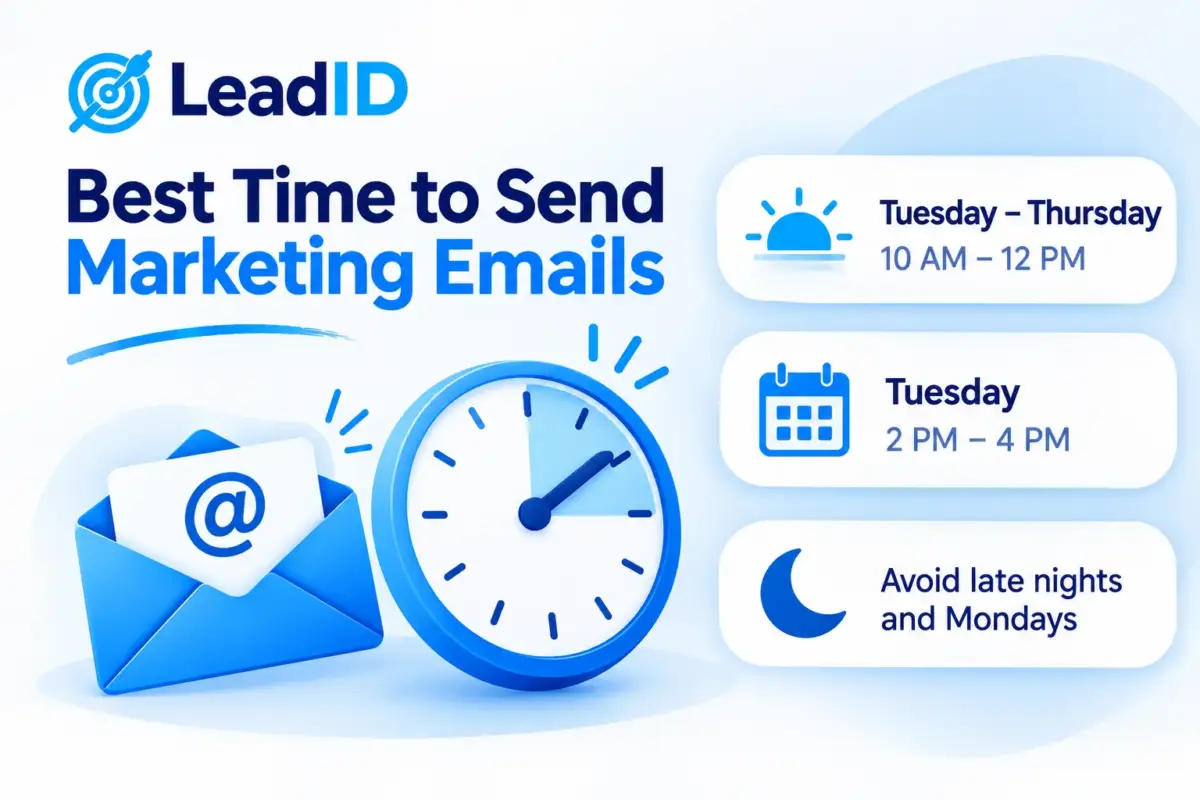
The best time to send marketing emails is Tuesday to Thursday, 9 to 11 AM in the recipient’s local time zone. That is the default. It beats every other default in the 2026 Omnisend study, in Moosend’s 10-billion-email analysis, and in HubSpot’s marketer survey.
If you optimize for conversions rather than opens, move the send to Friday 7 AM. If you want the highest click-to-sent rate anywhere in the week, use Wednesday 4 PM. If you serve a newsletter or lifestyle audience, test Sunday 11 AM against your current best slot and watch what happens.
The one rule that beats every vendor average: send in the recipient’s local time, not yours. The one measurement that beats open rate: conversion rate. Signal-based cold email personalization plus the right send time compound into real lift, which is why most teams see their biggest reply-rate gains after fixing both at once.
FAQs
1- What is the best time to send marketing emails in 2026?
Tuesday to Thursday, 9 to 11 AM in the recipient’s local time zone. Omnisend’s 2026 study of 26 billion emails, Moosend’s 10-billion-email dataset, and HubSpot’s 2025 marketer survey all converge on this window. For conversions specifically, Friday 7 AM beats every other hour.
2- What is the best day to send marketing emails?
Tuesday for opens (31.27% average per Omnisend 2026), Friday for conversions (0.138% peak hourly), and Sunday for the highest single-hour open rate of the week (33.69% at 11 AM). The gap between the top three days is small, so audience fit matters more than universal “best day” claims.
3- What is the best time to send an email on Friday?
7 AM recipient local for conversions, 9 AM for opens, 4 PM for clicks. Friday 7 AM is Omnisend’s single highest conversion hour of the week at 0.138%. Avoid Friday afternoons for anything that needs a reply. Response rates collapse once readers switch into weekend mode.
4- What is the best time to send email on Thursday?
2 PM recipient local for opens, 8 AM for clicks, 10 AM for conversions. Moosend’s analysis of 10 billion emails ranks Thursday as the best weekday for opens overall. Thursday has the highest campaign send volume industry-wide, so inbox competition is at its weekly peak.
5- What is the best time to send marketing emails on Monday?
1 PM local for opens, 8 AM for conversions. Monday mornings underperform because readers spend the first two hours clearing weekend backlog. The 1 PM slot catches the post-lunch window before meetings pile up.
6- What is the best time to send cold emails specifically?
Tuesday to Thursday, 8 to 10 AM recipient local time. Cold emails need to catch the prospect in a receptive window because there is no prior relationship to lean on. A sharp subject line hitting at 8 AM Tuesday out-performs the same line at 2 PM Thursday by roughly 20% in reply rate.
7- Does send time really matter, or is this all overblown?
Timing moves engagement by 10 to 25% in most tests, which is real but not game-changing. List quality, subject line, and offer each matter more. If you have to pick one optimization to run, pick list growth first, subject-line testing second, and send-time third.
8- Should I send in my time zone or the recipient’s?
The recipient’s, always. HubSpot calls it Time Zone Send, Mailchimp calls it Timewarp, Omnisend and Instantly call it recipient time zone optimization. Enabling it lifts engagement 15 to 25% for global lists without changing anything else.
9- What is the best time to send B2B emails specifically?
Tuesday to Thursday, 9 to 12 AM recipient local. HubSpot’s 2025 survey found 47.9% of B2B marketers saw their best engagement in this window. Avoid Monday mornings, Friday afternoons, and weekends for B2B sends. Knowledge workers process email in two bursts (morning and after lunch) and the morning burst produces more clicks.
10- What is the best time to send B2C emails?
More flexibility than B2B. Weekday mornings still work, but evenings (6 to 9 PM) and weekends also convert well because consumers check personal email at home. Friday 7 PM is strong for leisure and apparel. Sunday 11 AM works for newsletters and lifestyle content.



Pingback: Best Email Marketing Campaigns 2026: 12 Real Brand Examples
Pingback: Gmail Sending Limits In 2026: Every Official Number From Google
Pingback: Welcome Email Examples: 12 That Convert + Series Frameworks For 2026
Pingback: How To Build An Email List In 2026 (Under New Sender Rules)
Pingback: Ecommerce Email Marketing: 2026 Strategy, Flows, and Rules - LeadID